
Artificial intelligence is changing the way businesses operate, products are developed, and services are delivered. As companies continue adopting AI-powered technologies, the demand for professionals who can build, manage, and apply these systems is expected to increase.
The AI Jobs That Will Be in Demand by 2030 will not be limited to traditional computer science positions. Opportunities are likely to appear across data science, software development, cybersecurity, robotics, business, healthcare, finance, and other industries.
According to the World Economic Forum’s Future of Jobs Report 2025, AI and machine learning specialists, big data specialists, software developers, and several other technology-related roles are among the fastest-growing occupations toward 2030.
1. AI and Machine Learning Specialists

AI and machine learning specialists are expected to remain among the most valuable technology professionals. These experts develop systems that can analyze information, identify patterns, make predictions, and perform tasks that normally require human intelligence.
Companies may need machine learning professionals for recommendation systems, fraud detection, automation, virtual assistants, image recognition, and predictive analytics.
A strong foundation in programming, statistics, mathematics, and machine learning can help people prepare for this career.
2. Data Scientists
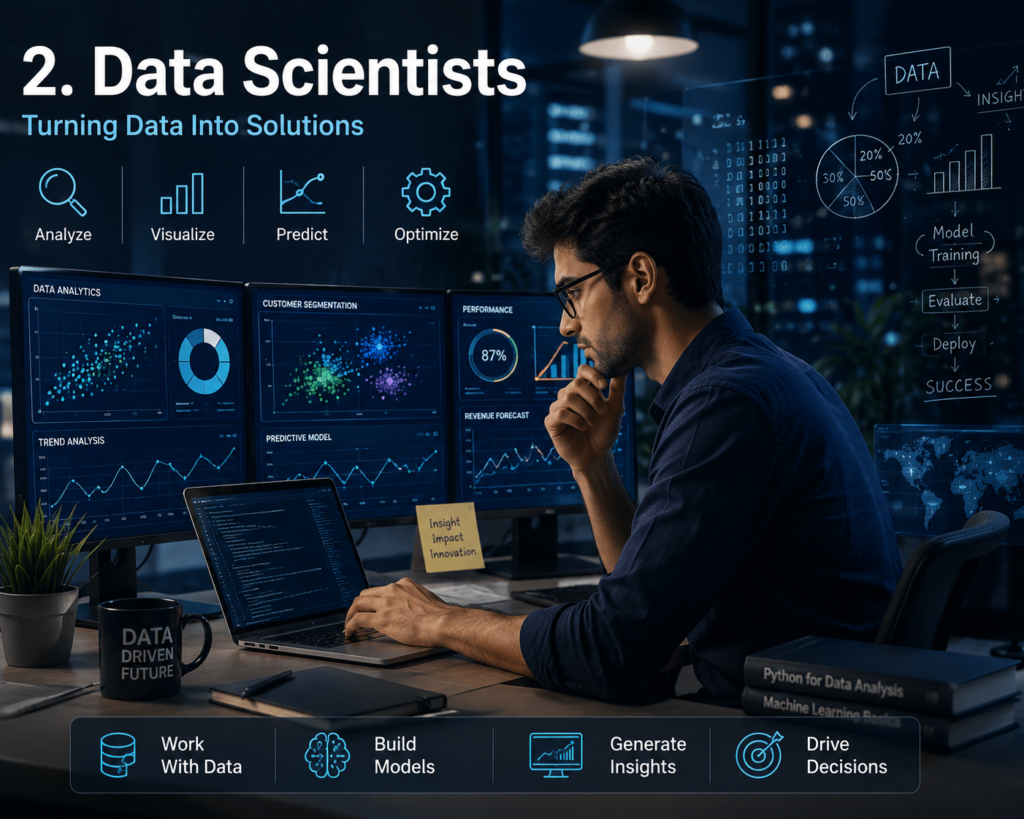
Data has become an important resource for modern businesses. Data scientists help organizations turn large amounts of information into useful insights.
They collect and analyze data, create predictive models, identify trends, and help companies make better decisions.
The U.S. Bureau of Labor Statistics projects strong employment growth for data scientists, with employment expected to increase by 33.5% from 2024 to 2034.
This makes data science an attractive career path for people interested in both technology and analytical problem-solving.
3. AI Engineers
AI engineers focus on developing and implementing artificial intelligence solutions. Their work can involve machine learning models, natural language processing, computer vision, generative AI, and automation systems.
As businesses integrate AI into everyday operations, organizations will need professionals who can connect AI technology with real-world business requirements.
AI engineers may work with programming languages such as Python and technologies used for machine learning, cloud computing, and data processing.
4. Big Data Specialists

The growth of AI depends heavily on data. Big data specialists manage and organize huge datasets so that businesses can use them effectively.
Their responsibilities can include building data systems, processing information, maintaining data pipelines, and helping AI applications access reliable data.
The World Economic Forum identifies Big Data Specialists as one of the fastest-growing job roles toward 2030.
5. AI Software Developers
Software development is also being transformed by artificial intelligence. Developers are increasingly using AI tools to write, test, debug, and improve software.
However, businesses will still need skilled developers who understand software architecture, programming, security, databases, and system design.
The future may favor developers who know how to combine traditional programming knowledge with AI-assisted development techniques.
6. AI Cybersecurity Specialists

As businesses increasingly rely on online technologies, protecting digital information and systems has become a major priority. AI can help security teams identify unusual activity, detect threats, and respond to potential attacks.
This creates opportunities for professionals who understand both artificial intelligence and cybersecurity.
The World Economic Forum lists networks and cybersecurity among the fastest-growing skill areas toward 2030.
7. Robotics and Automation Specialists
AI is becoming increasingly connected with robotics and automated systems. Industries such as manufacturing, logistics, healthcare, and transportation can use intelligent machines to perform repetitive or complex tasks.
Robotics specialists may design, program, test, and maintain these systems. Knowledge of AI, robotics, engineering, programming, and automation can be valuable in this field.
8. AI Product Managers
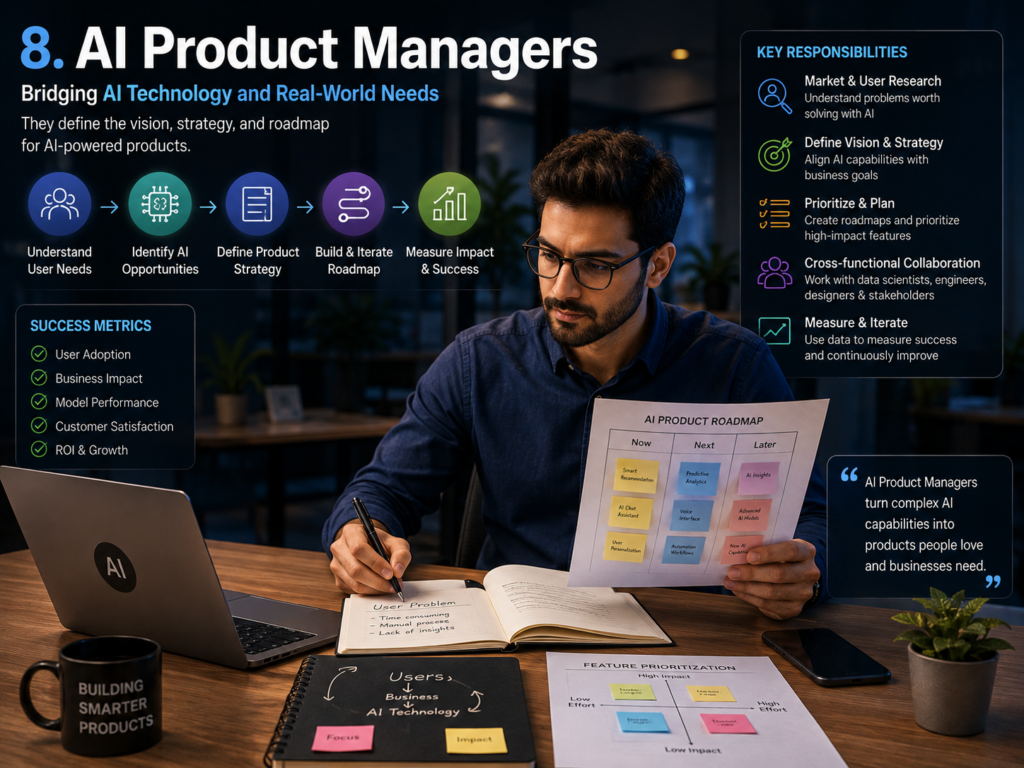
Not every AI career requires advanced programming. AI product managers combine technology knowledge with business and customer understanding.
They help organizations decide which AI products to develop, what problems they should solve, and how those products should be improved.
This role can be particularly valuable as businesses move from experimenting with AI to using it as part of their core operations.
9. AI Ethics and Governance Professionals
AI systems can raise important questions about privacy, fairness, security, transparency, and responsible use. As AI adoption expands, organizations may need professionals who can help establish responsible policies and governance practices.
These specialists may work with technical teams, legal departments, executives, and regulators to make sure AI systems are developed and used appropriately.
10. AI Consultants
AI consultants help businesses understand where artificial intelligence can provide practical value. They may analyze business processes, recommend AI solutions, support implementation, and help employees adapt to new technologies.
This career can suit professionals who combine AI knowledge with communication, business strategy, and problem-solving skills.
Skills Needed for Future AI Careers
Learning AI technology alone may not be enough. Employers are expected to value a combination of technical and human abilities.
Important technical skills can include:
- Artificial intelligence
- Machine learning
- Data analysis
- Programming
- Cloud computing
- Cybersecurity
- Big data
- Automation
- Database management
Human skills will also remain important. The World Economic Forum highlights analytical thinking, creative thinking, resilience, flexibility, leadership, and collaboration as important skills for the changing workplace.
Will AI Replace Jobs?

AI is expected to change many jobs, but that does not mean every occupation will disappear. Some tasks may become automated while new responsibilities and job categories emerge.
The World Economic Forum estimates that broader labor-market changes could create 170 million jobs and displace 92 million jobs globally by 2030, resulting in a net increase of 78 million jobs.
This shows why workers should focus on adaptability rather than assuming that technology will simply eliminate employment.
How to Prepare for an AI Career
People interested in future AI careers can start by learning the fundamentals. Beginners may begin with basic programming, especially Python, before moving toward data analysis and machine learning.
Practical projects are also useful. Building a simple chatbot, analyzing a dataset, creating an AI-powered application, or experimenting with automation can provide valuable experience.
Continuous learning will be important because AI technologies are developing quickly. Workers who regularly update their skills may have a better chance of remaining competitive in the changing job market.
Conclusion
The AI Jobs That Will Be in Demand by 2030 are likely to cover many different areas, including machine learning, data science, software development, cybersecurity, robotics, AI product management, and AI governance.
AI will not simply create jobs for people who build algorithms. It will also create opportunities for professionals who can connect technology with business needs and human problems.
For anyone planning a technology career, developing a combination of technical knowledge, analytical thinking, creativity, communication, and adaptability can provide a strong foundation for the future.