

Copywriting is an important part of modern marketing, online business, and digital communication. Almost every business uses written content to introduce its products, explain services, connect with potential customers, and encourage people to take action. From website landing pages and social media advertisements to promotional emails and product descriptions, persuasive writing plays a significant role in how businesses communicate with their audiences.
If you have ever read an advertisement that made you interested in a product or visited a website that convinced you to sign up for a service, you have probably experienced the impact of copywriting.
But what is copywriting, how does it work, and why do businesses need it?
Copywriting is the practice of creating persuasive written content that encourages readers to perform a particular action. That action might involve purchasing a product, subscribing to a newsletter, downloading an application, requesting information, or visiting a website.
In this guide, you will learn about the meaning of copywriting, its different types, essential writing techniques, practical examples, required skills, and ways to start a copywriting career.
1. What Is Copywriting?

Copywriting is the process of writing clear, persuasive, and engaging content designed to influence an audience and encourage a specific response. A person who creates this type of content is called a copywriter.
The main purpose of copywriting is to communicate the value of a product, service, brand, or idea in a way that connects with the reader’s needs and interests.
For example, imagine an online store selling wireless headphones. A basic product description might simply say:
“These wireless headphones provide high-quality sound and comfortable ear cushions.”
A more persuasive version could say:
“Enjoy your favorite music with clear sound and comfortable headphones designed for everyday listening.”
Both descriptions communicate product information, but the second focuses more directly on the customer’s experience.
Copywriting is not simply about using attractive words. It involves understanding the target audience, identifying their problems, explaining relevant benefits, and presenting a clear reason to take action.
Businesses use copywriting across different marketing channels, including:
- Business websites
- Online advertisements
- Social media campaigns
- Email newsletters
- Landing pages
- Product descriptions
- Sales brochures
- Promotional campaigns
Effective copywriting combines useful information, persuasive language, and a clear message. Its purpose is to help readers understand why an offer may be valuable to them.
2. How Does Copywriting Work?
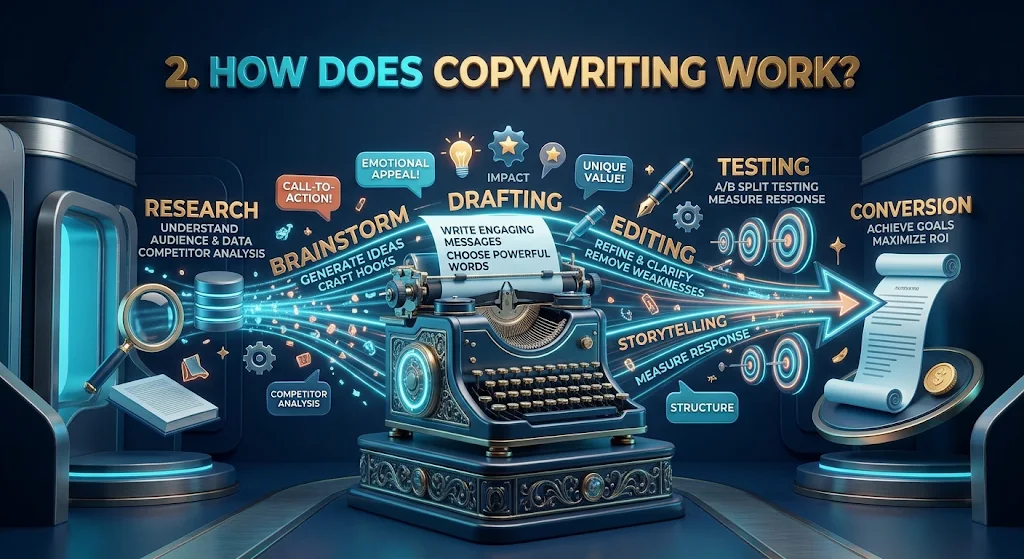
Copywriting works by connecting a business message with the needs, interests, and expectations of its intended audience. Instead of simply describing a product, a copywriter explains how it can provide value or solve a particular problem.
The process usually begins with research. A writer needs to understand what potential customers want, what challenges they face, and what information could help them make a decision.
After understanding the audience, the copywriter develops a message that communicates the product’s benefits in a straightforward way.
Here are the major steps involved in the copywriting process.
Understanding the Target Audience
Before writing promotional content, it is important to identify who will read it. Different audiences have different interests, expectations, and purchasing habits.
For example, an advertisement for a beginner-friendly website builder may focus on simplicity and ease of use. However, content targeting experienced developers might highlight customization options and technical features.
Identifying the Customer’s Problem
Effective copywriting often starts by identifying a problem that the audience wants to solve.
For example, people looking for website hosting may be concerned about slow loading times, unreliable servers, or complicated website management.
A good copywriter addresses these concerns and explains how the advertised service can help.
Presenting the Benefits
Product features describe what something offers, while benefits explain why those features matter to the customer.
For example, a smartphone might come equipped with a high-capacity battery. The practical benefit is that users can spend more time using their device without frequently charging it.
Adding a Call to Action
A Call to Action (CTA) encourages visitors to take the desired action.
Examples include:
- Buy Now
- Get Started
- Download Today
- Learn More
- Subscribe for Updates
- Request a Free Quote
A clear CTA helps readers understand the next step instead of leaving them uncertain about what to do.
3. What Are the Main Types of Copywriting?

Copywriting covers several forms of marketing communication. Each type has a different purpose, audience, and platform.
Understanding these categories can help beginners decide which area they want to explore.
1. SEO Copywriting
SEO copywriting involves creating useful and engaging website content while considering how people search for information online.
It includes naturally using relevant keywords, organizing information with descriptive headings, writing informative page titles, and answering search-related questions.
For example, an article targeting the keyword “best website hosting for beginners” should explain hosting options, important features, and factors readers should consider before choosing a provider.
The objective is to help readers find useful information while making the page easier for search engines to understand.
2. Advertising Copywriting
Advertising copywriting focuses on creating promotional messages for advertisements.
These messages may appear on search engines, websites, social media platforms, or other advertising channels.
For example:
“Create Your First Website Today. Explore Simple Tools Designed for Beginners.”
Good advertising copy communicates the main offer quickly and encourages the audience to learn more.
3. Email Copywriting
Email copywriting involves writing messages that businesses send to subscribers, customers, or potential clients.
These emails may introduce new products, share company updates, announce discounts, or provide helpful information.
A successful marketing email usually includes an interesting subject line, relevant content, and a clear next step.
4. Social Media Copywriting
Social media copywriting focuses on creating short and engaging messages for platforms such as Facebook, Instagram, LinkedIn, and other social networks.
The content may include captions, promotional messages, product announcements, and educational posts.
Writers need to consider the platform, audience expectations, and preferred communication style.
5. Website Copywriting
Website copywriting involves creating content for important website pages, including homepages, service pages, about pages, and landing pages.
Its purpose is to explain what a business offers, communicate its value, and help visitors find the information they need.
6. Product Copywriting
Product copywriting focuses on describing products in a way that helps potential buyers understand their features and benefits.
Online stores commonly use product descriptions to explain specifications, materials, functionality, and practical uses.
Clear and accurate descriptions help customers make informed purchasing decisions.
4. What Makes Good Copywriting Effective?
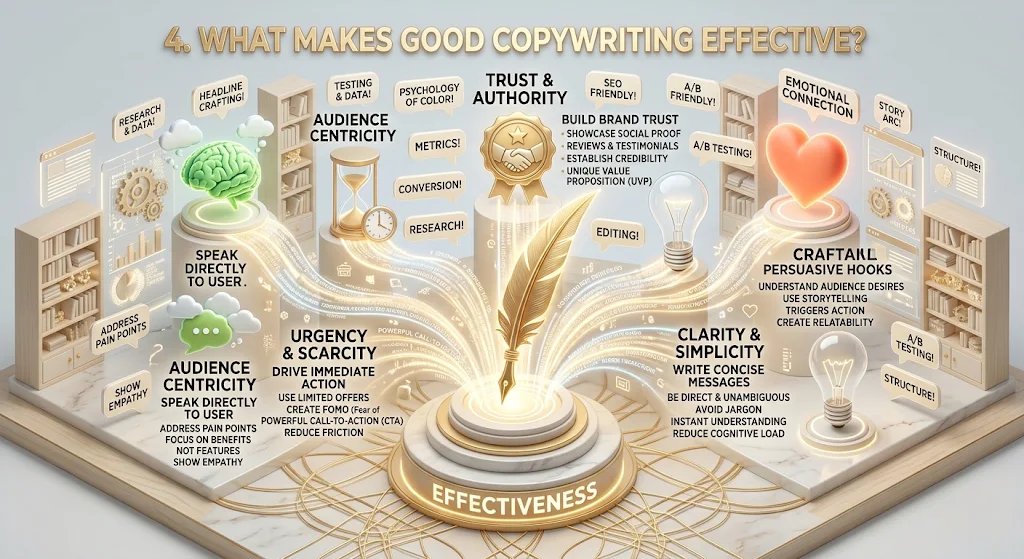
Successful copywriting is based on more than persuasive language. It requires a clear understanding of the audience and a message that communicates value without creating confusion.
Several important elements contribute to effective copy.
A Strong Headline
The headline is often the first thing readers notice. It should communicate the main topic or benefit and encourage people to continue reading.
For example:
“How to Build a Professional Website Without Coding Experience”
This headline tells readers exactly what they can learn.
Simple and Clear Language
Readers should understand the message without having to interpret complicated sentences.
Using familiar words, short paragraphs, and clear explanations can make promotional content easier to read.
Customer-Focused Benefits
Rather than concentrating entirely on product features, effective copy explains how those features help the intended audience.
This makes the message more relevant to potential customers.
Trustworthy Information
Copywriting should communicate accurate information. Unsupported promises, misleading claims, and exaggerated benefits can damage customer trust.
Including relevant evidence, clear product details, and genuine customer feedback can make a message more credible.
A Clear Call to Action
Every promotional message should have a suitable next step when an action is expected.
The CTA should be relevant to the reader’s position in the buying process. Someone learning about a product may prefer to explore a guide, while someone ready to purchase may respond to a shopping link.
Good Content Structure
Headings, bullet points, and short paragraphs help readers understand information quickly.
A well-organized message also makes it easier to identify the most important details.
5. How to Start Copywriting as a Beginner

Starting a copywriting journey does not necessarily require a professional degree or years of marketing experience. Beginners can develop their abilities through consistent practice, research, and feedback.
However, learning the fundamentals before offering professional services is important.
Step 1: Learn the Basics
Start by understanding persuasive writing, audience research, marketing principles, and basic content structure.
Read different advertisements, product descriptions, and landing pages to observe how businesses communicate their offers.
Step 2: Study Successful Examples
Analyze marketing messages from different industries.
Pay attention to their headlines, language, benefits, and calls to action.
Ask yourself why a particular message is interesting and what makes its offer understandable.
Step 3: Practice Different Writing Formats
Do not limit your practice to one type of content.
Try writing:
- A product description
- A short social media advertisement
- A promotional email
- A website homepage introduction
- A landing page headline
- A search-friendly article introduction
Working with different formats helps you understand how writing changes according to the platform and audience.
Step 4: Build a Portfolio
A portfolio is a collection of writing samples that demonstrates your abilities.
You can create sample projects for imaginary businesses or rewrite general promotional examples using your own original wording.
Organize your work by content type so potential clients can easily review your skills.
Step 5: Learn Basic SEO
Understanding SEO can improve your ability to create website content.
Learn about keyword research, search intent, internal linking, headings, meta descriptions, and content organization.
For additional website-building knowledge, you can explore DevFreeHub’s guide to the best free WordPress themes for beginners.
Step 6: Improve Through Feedback
Reviewing your writing helps you identify unclear sentences, unnecessary words, and weak arguments.
Ask other people to read your work and explain which parts are useful or confusing.
Use their feedback to improve your next draft.
6. Essential Skills Every Copywriter Should Develop

Copywriting requires a combination of writing ability, research, communication, and marketing knowledge.
Developing these skills can help beginners produce better content and work more confidently with clients.
Writing and Editing Skills
A copywriter should know how to communicate ideas clearly. Grammar, spelling, sentence structure, and editing are important because writing mistakes can make a business appear less professional.
Research Skills
Research helps writers understand products, services, industries, and customer expectations.
Before making a claim, copywriters should verify information using reliable sources.
Audience Understanding
Understanding customer interests and challenges helps writers create relevant messages.
A copywriter should consider what readers already know, what questions they may have, and what information they need before making a decision.
Creativity
Creative thinking helps writers develop interesting headlines, fresh ideas, and engaging ways to explain products.
However, creativity should support the message rather than make it difficult to understand.
SEO Knowledge
SEO knowledge is particularly useful for writers creating website content.
Understanding keywords, search intent, page structure, and internal links helps make content more accessible to both readers and search engines.
Communication Skills
Professional copywriters often work with business owners, marketing teams, designers, and clients.
Clear communication helps them understand project requirements and deliver content that matches the intended goals.
Adaptability
Different industries and platforms require different writing styles.
A social media advertisement may need a short and conversational message, while a business website may require detailed and professional explanations.
A flexible copywriter can adjust their approach according to the project.
7. Copywriting for SEO, AEO, and GEO
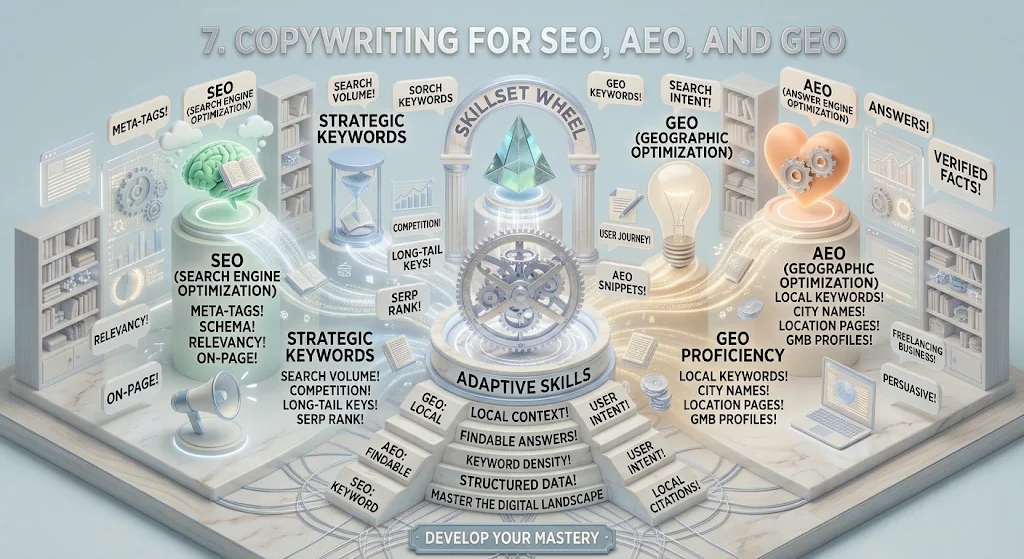
Modern digital content needs to serve readers while remaining understandable to different search and information-discovery systems.
SEO, AEO, and GEO are related approaches, but each has a different emphasis.
Search Engine Optimization (SEO)
SEO stands for Search Engine Optimization. It involves improving website content and technical elements to help search engines discover, understand, and present relevant pages.
For copywriters, SEO-friendly writing includes:
- Understanding the main search keyword.
- Identifying the reader’s search intent.
- Using descriptive headings.
- Writing informative title tags and meta descriptions.
- Adding relevant internal links.
- Providing accurate and helpful information.
- Organizing content for easy reading.
Keywords should appear naturally. Repeating the same phrase unnecessarily can reduce readability and make the content less useful.
Answer Engine Optimization (AEO)
AEO stands for Answer Engine Optimization. It focuses on making information easy for answer-oriented search experiences to understand and present.
Copywriters can support AEO by providing direct answers to common questions.
For example, if someone searches “What is copywriting?”, an article should provide a clear definition near the beginning instead of making readers search through several paragraphs.
Helpful AEO practices include:
- Answering questions directly.
- Using descriptive question-based headings.
- Including relevant FAQs.
- Explaining technical terms.
- Providing concise definitions.
- Supporting important claims with reliable information.
Generative Engine Optimization (GEO)
GEO refers to preparing content so that generative AI search and information systems can understand, evaluate, and potentially reference it.
Useful GEO practices include:
- Publishing original and informative explanations.
- Organizing information logically.
- Including relevant examples.
- Using clear terminology.
- Providing accurate and verifiable details.
- Demonstrating subject knowledge.
- Keeping important information consistent throughout the article.
No writing technique guarantees that an AI system will select or cite a particular page. The goal is to create useful, understandable, and trustworthy information.
When SEO, AEO, and GEO principles are combined with strong copywriting, content can provide a better experience for readers and become easier for different information systems to interpret.
8. Copywriting Examples and Practical Benefits

Practical examples make it easier to understand how copywriting works in everyday business situations.
Consider a small business selling website design services.
A basic promotional message might say:
“We provide website design services for businesses.”
This statement explains the service, but it does not communicate much about its value.
A more audience-focused version could say:
“Build a professional online presence with a website designed to showcase your business, explain your services, and help customers find you.”
The second version gives readers a better understanding of the potential benefits.
Here are additional examples of copywriting in different situations.
Example 1: Social Media Advertisement
“Looking to create your first website? Explore beginner-friendly tools and take the first step toward building your online presence.”
Example 2: Product Description
“Keep your workspace organized with a compact desk organizer designed to store everyday office supplies within easy reach.”
Example 3: Email Marketing
“Discover our latest collection and explore useful products selected to make your everyday routine easier.”
Example 4: Website Headline
“Simple Website Solutions for Growing Businesses”
These examples show how different messages can communicate value according to the product, audience, and platform.
Why Do Businesses Need Copywriting?
Copywriting offers several benefits to businesses when it is based on accurate information and a clear marketing strategy.
- Improves Communication: It helps businesses explain their products and services in understandable language.
- Builds Brand Identity: Consistent messaging helps customers recognize a company’s personality and values.
- Supports Marketing Campaigns: Promotional content communicates offers and encourages relevant customer actions.
- Improves Website Experience: Clear website copy helps visitors understand what a business provides.
- Supports Customer Trust: Accurate descriptions and transparent communication help establish credibility.
- Encourages Engagement: Relevant messages can motivate readers to explore content and interact with a brand.
- Supports Sales Activities: Persuasive product descriptions and landing pages can help customers make informed purchasing decisions.
The results of copywriting depend on several factors, including the quality of the offer, audience needs, competition, pricing, and overall marketing strategy.
Conclusion
Copywriting is an essential communication skill in modern marketing. It helps businesses explain their products, connect with potential customers, communicate benefits, and encourage meaningful actions.
Understanding what copywriting is provides a useful starting point for anyone interested in digital marketing, freelance writing, advertising, or online business.
To become a better copywriter, focus on understanding your audience, researching topics carefully, writing clear messages, and practicing different content formats. Learning SEO, AEO, and GEO principles can also help you create content that is useful to readers and understandable to modern search and information systems.
Frequently Asked Questions About Copywriting
1. What is copywriting in simple words?
Copywriting means writing persuasive content that encourages people to take a particular action. It is commonly used in advertisements, websites, emails, and product descriptions.
2. What is the main purpose of copywriting?
The main purpose of copywriting is to communicate a message effectively and encourage a desired response, such as purchasing a product, subscribing to a service, or requesting more information.
3. What are the five common types of copywriting?
Five common types include SEO copywriting, advertising copywriting, email copywriting, social media copywriting, and website copywriting. Each serves a different marketing purpose.
4. What is the difference between copywriting and content writing?
Copywriting generally focuses on persuading readers to take an action, while content writing often focuses on educating, informing, or entertaining an audience. However, both can overlap in digital marketing.
5. Can beginners learn copywriting?
Yes. Beginners can learn copywriting through regular practice, marketing research, studying successful examples, and developing their writing and communication skills.
6. Do copywriters need SEO knowledge?
SEO knowledge is valuable for copywriters who create website content. Understanding keywords, search intent, headings, and internal linking can help them produce more search-friendly content.
7. Is copywriting a good career choice?
Copywriting can be a suitable career for people who enjoy writing, research, communication, and marketing. Opportunities exist in agencies, businesses, freelance marketplaces, and independent projects.
8. What tools do copywriters use?
Copywriters may use grammar checkers, keyword research platforms, document editors, plagiarism checkers, analytics tools, and AI writing assistants. The right tools depend on the type of project.
9. How can I practice copywriting?
You can practice by writing product descriptions, advertisements, email campaigns, website headlines, and social media posts. Reviewing your work and receiving feedback can help you improve.
10. Can AI replace professional copywriters?
AI tools can assist with brainstorming, research, outlines, and initial drafts. However, human judgment remains important for understanding audiences, verifying facts, maintaining brand voice, and making strategic decisions.