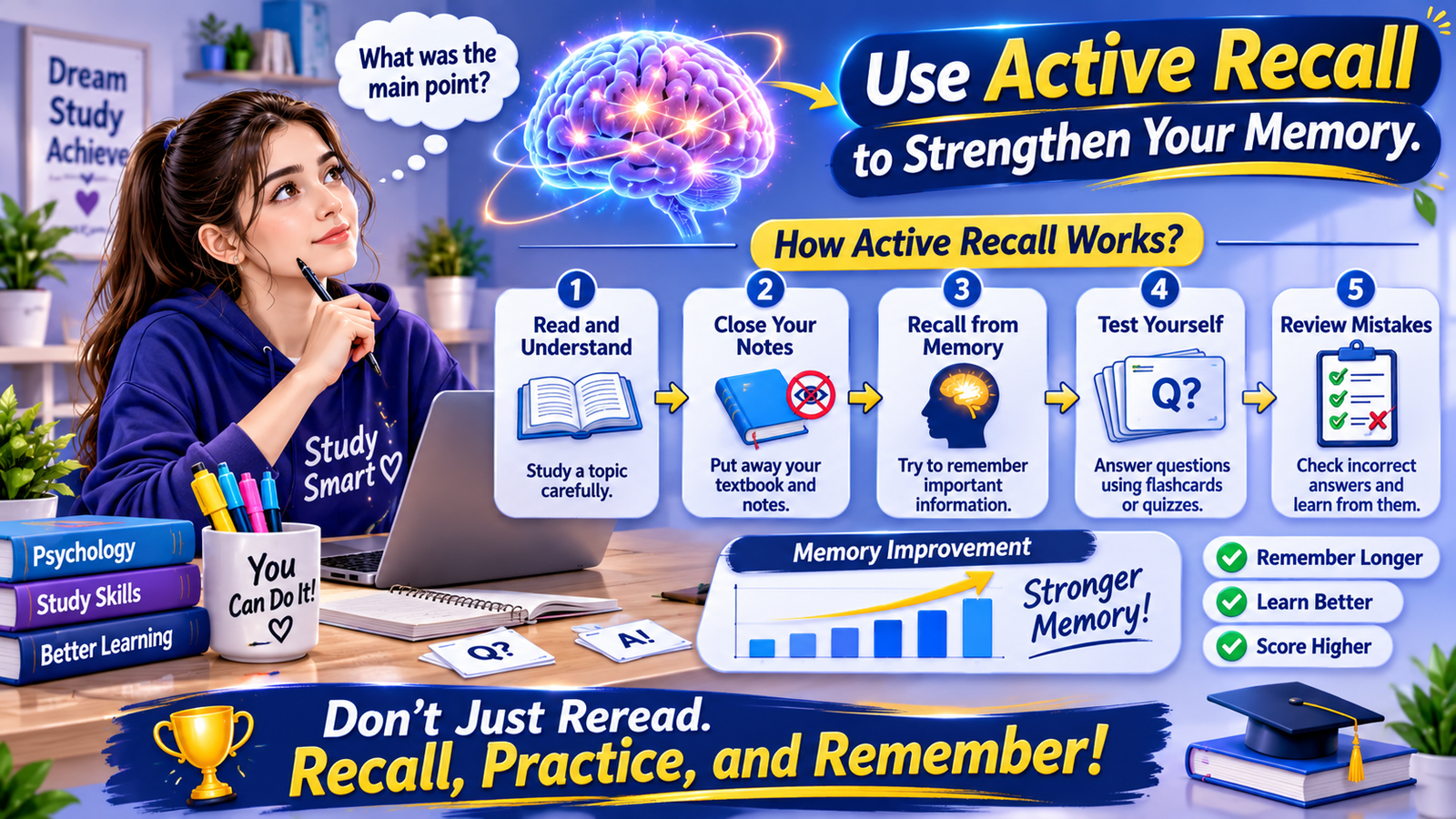

Academic learning is not simply about reading textbooks or spending an entire evening studying. Many students dedicate considerable time to their education but still find it difficult to remember lessons, understand challenging concepts, or perform confidently in examinations. The reason often lies in the way they approach learning. Choosing the best study techniques can help students make better use of their time, develop stronger understanding, and improve their overall educational experience.
Each learner brings their own strengths, challenges, and commitments. Some students understand information through examples, while others prefer written notes, diagrams, or practical exercises. Regardless of your learning preference, certain study strategies can make the learning process more organized and effective.
Instead of depending on repeated reading or memorizing everything at the last minute, students can use methods that encourage active thinking, regular revision, and practical application. These strategies can help build a more reliable foundation for long-term learning.
Whether you are preparing for school examinations, college assignments, university courses, or competitive tests, developing better study habits can support your academic goals. In this article, you will explore eight useful study techniques, learn how to apply them in your daily routine, and discover answers to common questions about effective studying.
1. Strengthen Your Understanding Through Active Recall
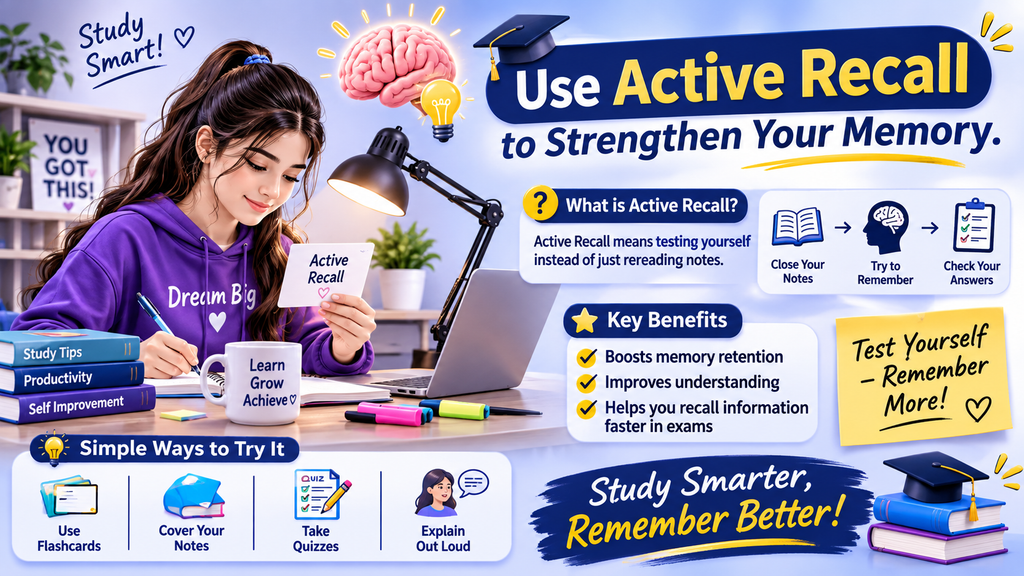
Active recall is a learning strategy that involves bringing information back from memory without immediately checking your textbook or notes. Rather than passively reviewing a lesson, you challenge yourself to remember the important concepts independently.
This technique can be especially useful because it reveals what you actually understand and which topics need additional attention. Reading a definition several times may make it familiar, but answering a question without assistance provides a clearer indication of your knowledge.
For example, after learning about the human digestive system, close your textbook and try to explain the function of the stomach, small intestine, and liver. If you cannot remember a particular function, return to your notes and review that section.
Practical Ways to Use Active Recall
- Create questions from each chapter before beginning revision.
- Cover your notes and write down everything you remember.
- Use flashcards containing questions and answers.
- Explain a concept aloud without reading from a book.
- Attempt short quizzes after completing a lesson.
- Check your responses and correct any misunderstandings.
Active recall can be applied to almost every academic subject. In mathematics, you can remember formulas and solve problems without checking the solution. History often involves remembering key dates, major events, and what led to them. In computer science, you can explain programming concepts or describe how an algorithm works.
A helpful exercise is the blank-page method. After studying a topic, take a blank sheet of paper and write down the major ideas from memory. Compare your notes with the original material to identify missing details.
The goal is not to achieve perfect recall immediately. Mistakes provide useful information about your learning progress. By revisiting difficult concepts and testing yourself again, you can gradually develop stronger knowledge.
2. Remember More Information with Spaced Revision
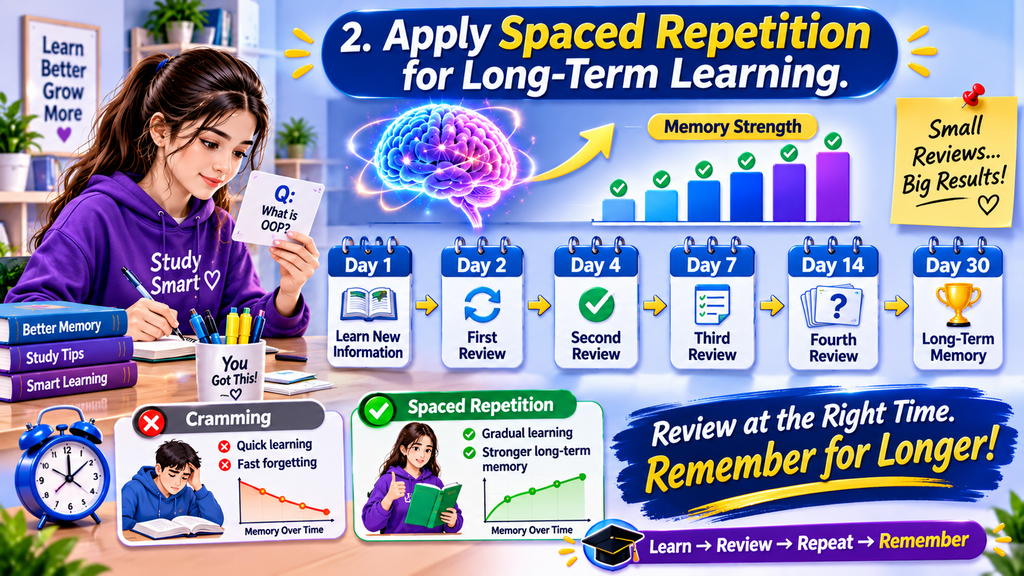
Spaced revision is a study method that involves reviewing information several times over a period rather than completing all revision in one sitting. It helps learners revisit material before it becomes too difficult to remember.
Many students study a chapter once and then ignore it until examination week. This can make revision stressful because they must relearn large amounts of information within a short period.
A better approach is to divide revision into smaller sessions. After learning a topic, return to it at different intervals. Each review gives you another opportunity to remember and reinforce the material.
Example of a Revision Plan
| Revision Activity | Suggested Day |
| Learn the topic | Day 1 |
| First revision | Day 2 |
| Second revision | Day 4 |
| Third revision | Day 7 |
| Fourth revision | Day 14 |
| Additional review | Day 30 |
This is a flexible example rather than a fixed rule. Difficult subjects may require more frequent revision, while familiar information may need fewer reviews.
Spaced revision becomes more useful when combined with active recall. Instead of reading the chapter again during every session, attempt to answer questions about it before checking your notes.
Students can organize their revision using calendars, notebooks, reminder applications, or flashcard tools. Keeping a simple record of completed reviews can also help prevent important topics from being forgotten.
This strategy is particularly helpful when preparing for examinations that cover several chapters. By revisiting lessons throughout the month, students can distribute their workload and avoid relying entirely on last-minute preparation.
3. Design a Study Space That Supports Concentration
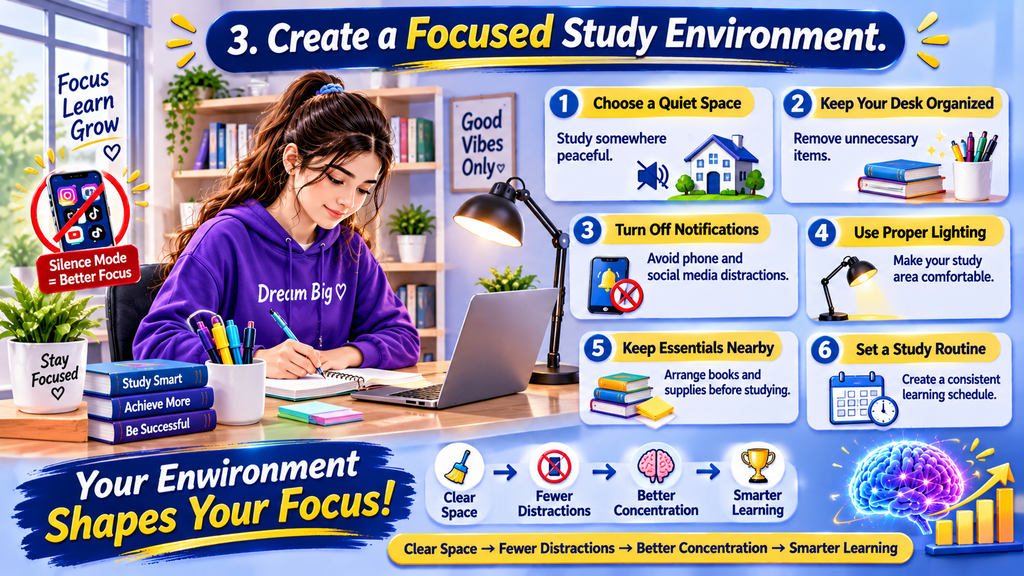
A suitable study environment can make it easier to begin work and maintain attention. If your workspace contains unnecessary distractions, you may spend more time switching between activities than actually learning.
A productive study area does not need expensive furniture or advanced equipment. Even a small desk or quiet corner can be useful if it is arranged according to your needs.
Start by keeping the materials required for your current subject nearby. Textbooks, notebooks, pens, and other supplies should be easy to access. This reduces unnecessary interruptions during a study session.
Steps to Create a Better Study Area
Choose a Comfortable Location
Select a place where you can read, write, and think without frequent interruptions. A library, quiet room, or organized home workspace may be suitable.
Reduce Digital Distractions
Silence unnecessary notifications and avoid opening social media platforms while studying. If you need your phone for educational purposes, use it only for the selected task.
Keep Your Workspace Organized
Remove unrelated books, empty papers, and objects that may distract you. An organized desk can make it easier to focus on the lesson.
Use Appropriate Lighting
Make sure your workspace has enough light for reading and writing comfortably. Avoid positioning your screen or book in a way that causes unnecessary glare.
Maintain a Comfortable Posture
Sit in a position that supports your back and allows your shoulders to remain relaxed. If you can, set your chair and desk to a comfortable working height.
Your ideal study environment depends on your personal preferences. Some students concentrate better in complete silence, while others prefer a quiet background sound. Experiment with different arrangements and choose the one that helps you work consistently.
4. Manage Study Time with the Pomodoro Method
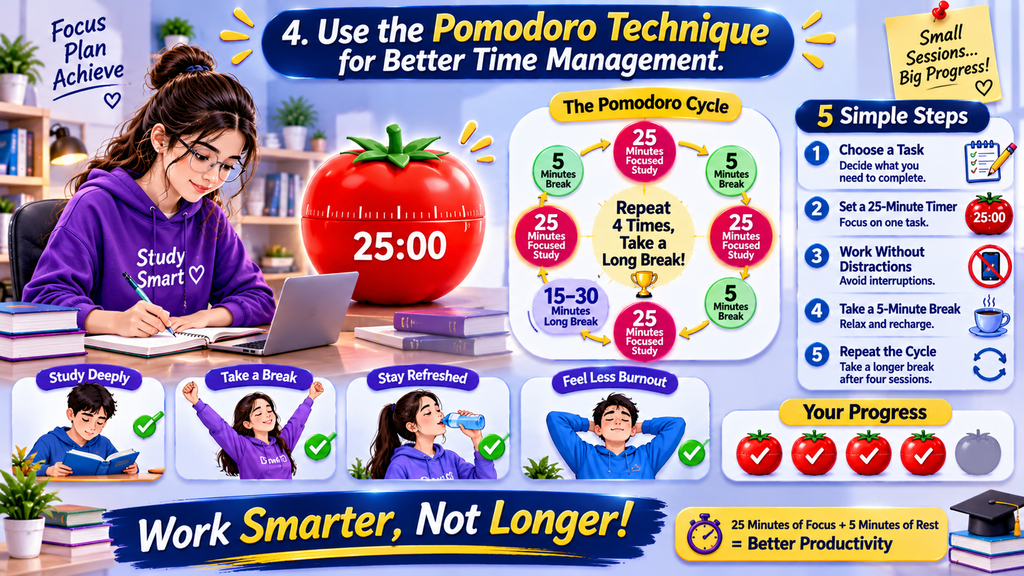
The Pomodoro Method is a time-management approach that divides work into focused intervals. It can help students manage difficult assignments, reduce procrastination, and organize their study sessions.
The commonly used format involves 25 minutes of focused work followed by a five-minute break. After completing four sessions, a longer break is taken.
The method encourages students to work on one task at a time instead of attempting to complete several activities simultaneously.
How to Follow the Pomodoro Method
- Select a clear study objective.
- Set a timer for 25 minutes.
- Concentrate on the selected task until the timer ends.
- Take a five-minute break.
- Repeat the process for additional sessions.
- Take a longer rest after four completed sessions.
For example, if you are preparing for a mathematics examination, your first session might focus on understanding a formula. The next session could involve solving related questions. A later session can be used to review mistakes and practice more challenging problems.
You can also adjust the session length according to your concentration level. Some learners prefer 30-minute sessions, while others work comfortably for 45 minutes before taking a break.
During breaks, try stretching, walking, drinking water, or resting your eyes. Activities that involve scrolling through social media may make it harder to return to your work.
The Pomodoro Method is not a requirement for every student. If you are deeply focused on a difficult concept, you may prefer to continue until you reach a natural stopping point. The important thing is to manage your time in a way that supports consistent learning.
5. Prepare Useful Notes Instead of Copying Entire Chapters
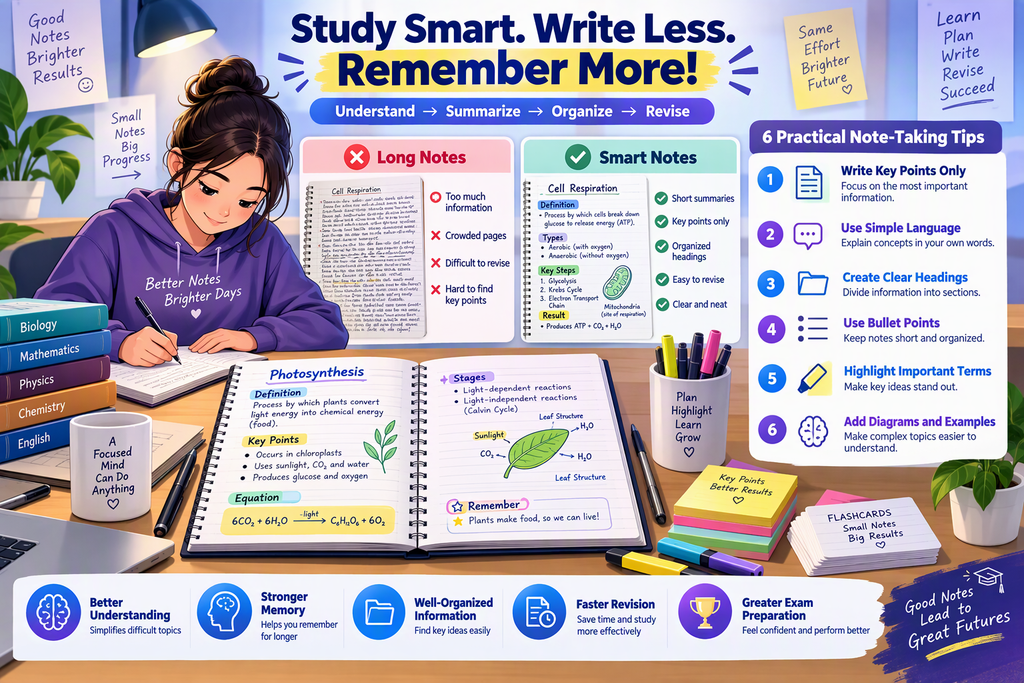
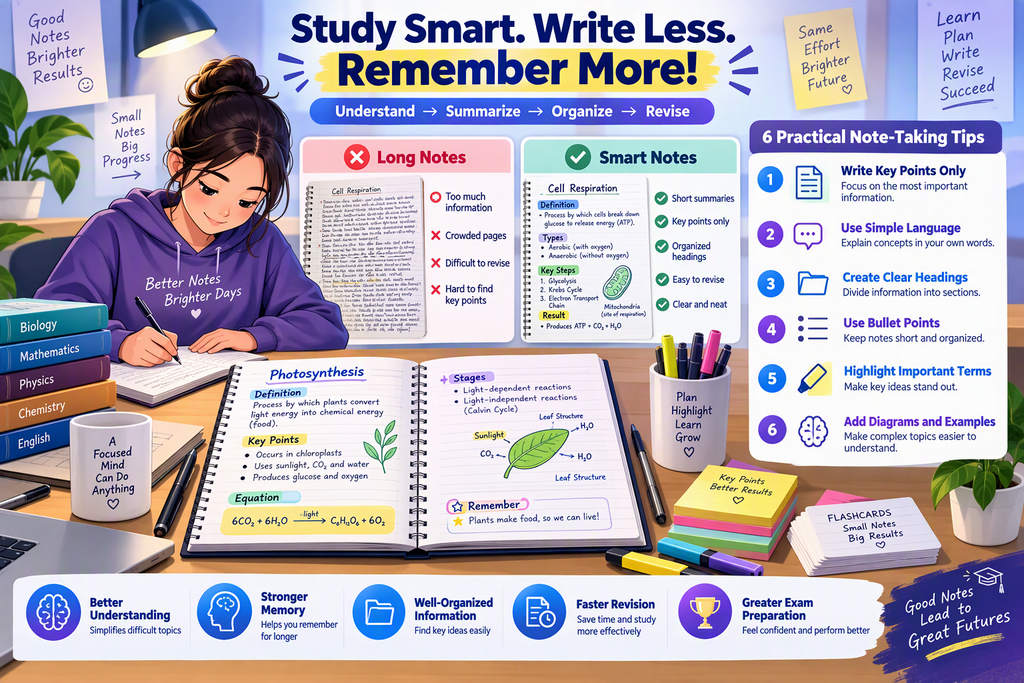
Study notes can become valuable revision resources when they are organized around important ideas. However, copying every sentence from a textbook may consume a considerable amount of time without helping you understand the subject more deeply.
Effective notes should summarize the main concepts, important definitions, formulas, examples, and relationships between ideas. Writing information in your own words can help you process the material more carefully.
Useful Note-Taking Approaches
Summarization
After completing a section, write a short explanation that includes its main points. Avoid unnecessary details unless they are important for the examination.
Mind Mapping
Place the central topic in the middle of a page and connect it to related concepts. This format is helpful for visualizing relationships between different ideas.
Question-Based Notes
Turn headings into questions. For example, a heading such as “Types of Computer Networks” can become “What are the different types of computer networks?”
Formula Sheets
For subjects such as mathematics, physics, and chemistry, create a separate page containing important formulas and brief explanations of when to use them.
Comparison Tables
Use tables to compare related concepts. For example, you can compare operating systems, programming languages, historical events, or scientific processes.
Avoid using too many colors or decorative elements if they do not improve understanding. The purpose of notes is to make information easier to review, not to create a visually complicated document.
After preparing your notes, use them for self-testing. Cover the explanations and try to recall the information from the headings alone. This turns note-taking into an active learning activity.
6. Improve Exam Preparation Through Practice Questions

Practice questions are an important part of effective learning. They allow students to apply their knowledge, evaluate their understanding, and become familiar with the types of questions they may encounter in examinations.
Reading a chapter can provide information, but solving questions shows whether you can use that information independently.
Students can practice through textbook exercises, quizzes, sample papers, previous examination questions, and mock tests.
How to Practice More Effectively
Begin with Basic Questions
Start with simple questions to confirm that you understand the main concepts. Move toward more challenging problems as your knowledge improves.
Attempt Questions Without Assistance
Try solving the questions before checking the answers. This helps you identify areas where your understanding may be incomplete.
Use Timed Practice
When preparing for a formal examination, complete selected questions within a realistic time limit. This can help you practice managing the available time.
Review Incorrect Answers
Do not ignore mistakes after checking your test. Identify why the answer was incorrect and study the relevant concept again.
Maintain a Mistake Record
Create a notebook containing difficult questions, incorrect answers, and explanations of the correct methods. Review this notebook before future examinations.
For example, a student preparing for an English examination can practice grammar exercises, vocabulary questions, reading comprehension, and writing tasks. A science student can solve numerical problems, explain diagrams, and answer conceptual questions.
Mock examinations can also help students become familiar with the examination format. However, practice should be followed by a careful review of results. Completing many tests without understanding mistakes may provide limited improvement.
7. Learn Difficult Concepts by Explaining Them Simply
One way to evaluate your understanding is to explain a topic in language that a beginner can understand. This approach is often associated with the Feynman Technique.
When you explain a concept, you must organize information, identify its main points, and make connections between ideas. If your explanation becomes confusing, it may indicate that you need to review the subject.
You can use this method with a study partner, friend, family member, or by speaking aloud to yourself.
A Simple Learning Process
Step 1: Select a Concept
Choose one topic from your current lesson. Avoid selecting an entire subject at once.
Step 2: Explain It in Simple Words
Imagine that you are teaching the concept to someone who has never studied it before.
Step 3: Find the Gaps
Notice any parts that you cannot explain clearly. These are areas that require additional attention.
Step 4: Review the Material
Return to your textbook, class notes, or other learning resources to clarify the difficult points.
Step 5: Improve Your Explanation
Try explaining the concept again using clearer language and relevant examples.
For instance, when learning about photosynthesis, you might explain that plants use light energy to produce food from water and carbon dioxide. If you cannot describe the role of chlorophyll or the process accurately, you can revisit those details.
This method is useful for conceptual subjects such as science, technology, mathematics, and social studies. It can also improve your ability to communicate ideas during presentations, interviews, and classroom discussions.
8. Develop a Realistic Routine for Consistent Learning
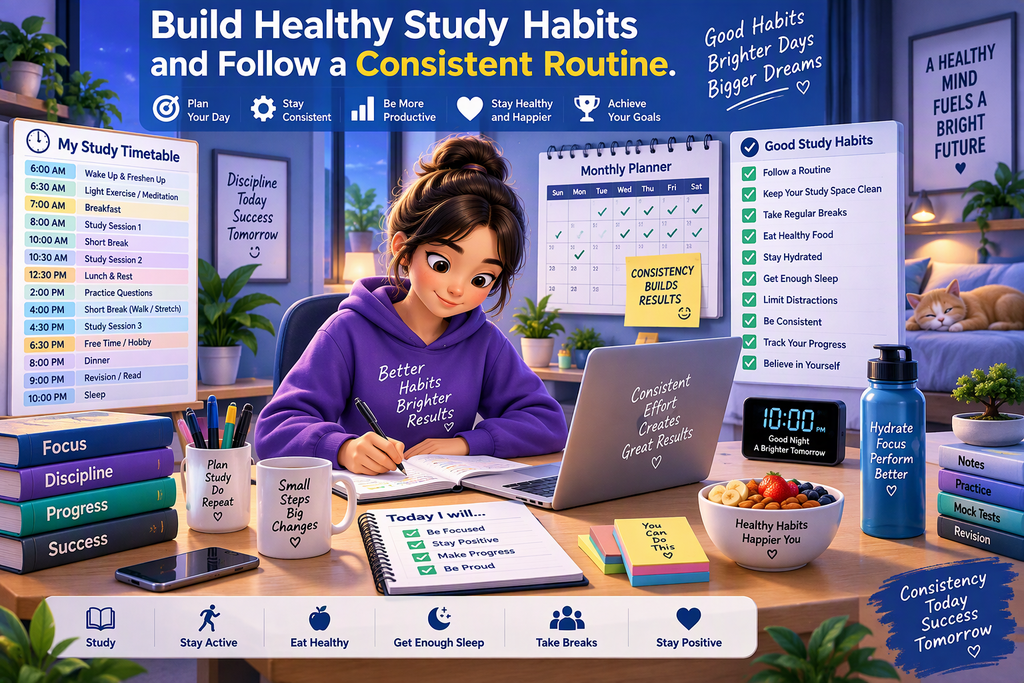
A well-planned study routine can help you maintain progress throughout the academic year. Instead of studying only when examinations are approaching, create a schedule that includes regular learning, revision, practice, and rest.
The most effective routine is one that fits your daily responsibilities. Students who attend school, college, or work may have different available study hours from those who study at home.
Begin by identifying the subjects that require the most attention. Assign suitable time to each subject and include short breaks between focused sessions.
Habits That Support Better Learning
Set Specific Goals
Replace general goals such as “Study mathematics” with measurable tasks like “Solve 10 algebra questions and review two formulas.”
Prioritize Challenging Topics
Use your most focused time for subjects that require deeper understanding. Familiar topics can be reviewed during shorter sessions.
Review Lessons Regularly
Spend some time revisiting earlier material instead of focusing exclusively on new chapters.
Protect Your Sleep
Adequate sleep is important for attention, memory, and general well-being. Avoid making late-night cramming a regular habit.
Take Breaks
Rest periods can help you manage fatigue during longer study sessions.
Stay Hydrated and Eat Regular Meals
Maintaining healthy daily habits supports your overall energy and comfort while studying.
Evaluate Your Progress
At the end of each week, check which tasks you completed and which subjects still need attention. Adjust the following week’s schedule accordingly.
Example of a Daily Study Routine
| Time | Study Activity |
| 4:00 PM – 4:25 PM | Review an earlier lesson |
| 4:25 PM – 4:30 PM | Short break |
| 4:30 PM – 4:55 PM | Learn a difficult concept |
| 4:55 PM – 5:05 PM | Rest |
| 5:05 PM – 5:30 PM | Solve practice questions |
| 5:30 PM – 5:35 PM | Short break |
| 5:35 PM – 6:00 PM | Revise notes and formulas |
| 6:00 PM – 6:10 PM | Self-test and check progress |
This timetable is an example, not a universal schedule. You can change the timing according to your classes, work, responsibilities, and examination requirements.
A consistent and realistic plan is more useful than a demanding timetable that you cannot maintain. Start with manageable goals and increase your workload when you feel comfortable.
Conclusion
The best study techniques can help students transform their learning habits and make their academic work more manageable. Effective studying is not simply about reading more pages or spending additional hours with textbooks. It involves understanding information, remembering important concepts, and applying knowledge when required.
Active recall, spaced revision, a distraction-free workspace, time management, organized notes, practice questions, self-explanation, and a consistent routine are valuable strategies for improving the learning experience.
Every student has different goals and responsibilities, so there is no need to adopt every method at once. Begin with the techniques that address your biggest challenges. If you struggle with memory, try active recall and spaced repetition. If you lose concentration, experiment with focused study sessions and a better workspace.
Track your progress, review your mistakes, and make gradual improvements to your routine. Consistency, patience, and a willingness to learn are important parts of academic development.
By using these strategies regularly, students can build stronger learning habits, approach examinations with greater confidence, and develop skills that remain useful beyond the classroom.
Frequently Asked Questions (FAQs)a
1. What are the best study techniques for students?
Useful study techniques include active recall, spaced revision, practice testing, focused study sessions, organized note-taking, and self-explanation. These approaches encourage students to engage with information instead of simply reading it repeatedly. The best combination depends on the subject and the learner’s needs.
2. How can I study smarter instead of studying longer?
Set clear objectives, remove distractions, and use methods that test your understanding. Active recall, practice questions, and planned revision can help you make better use of your study time. Focus on completing meaningful tasks rather than measuring success only by the number of hours spent studying.
3. Which study technique is best for improving memory?
Active recall and spaced repetition are useful techniques for memory improvement. Active recall involves retrieving information from memory, while spaced repetition involves revisiting material at different intervals. Combining these strategies can help support long-term learning.
4. How can I focus better while studying?
Choose a suitable workspace, keep your study materials organized, and silence unnecessary notifications. Set one clear goal for each session and avoid switching between unrelated tasks. Short breaks may also help you maintain concentration during longer study periods.
5. Is the Pomodoro Method effective for students?
The Pomodoro Method can be helpful for students who need a structured approach to time management. It uses focused work intervals followed by short breaks. The traditional format is 25 minutes of work and five minutes of rest, although students can adjust the duration.
6. How can I remember lessons for a long time?
Review lessons over several days, test yourself without looking at your notes, and explain concepts using your own words. Practice questions can help you identify knowledge gaps. Regular revision and adequate sleep may also support the learning process.
7. Are handwritten notes better than digital notes?
Both handwritten and digital notes can support learning. Handwritten notes may encourage summarization, while digital notes are convenient for searching, editing, and organizing information. Choose the format that makes your notes useful and easy to review.
8. How many hours should I study each day?
There is no single number of study hours that works for every student. The appropriate duration depends on your educational level, workload, subjects, and examination schedule. Focused study sessions with suitable breaks may be more useful than long periods of distracted work.
9. What should I do when a subject feels too difficult?
Divide the subject into smaller topics and begin with the fundamental concepts. Use examples, diagrams, practice questions, and simple explanations. If you remain confused, ask a teacher or study partner for assistance and revisit the topic regularly.
10. How can I prepare for examinations more effectively?
Organize your syllabus, create a realistic revision schedule, and identify topics that need extra attention. Use active recall, spaced repetition, and mock examinations to evaluate your progress. Review incorrect answers and avoid leaving all revision until the final days.
Conclusion
The best study techniques can help students transform their learning habits and make their academic work more manageable. Effective studying is not simply about reading more pages or spending additional hours with textbooks. It involves understanding information, remembering important concepts, and applying knowledge when required.
Active recall, spaced revision, a distraction-free workspace, time management, organized notes, practice questions, self-explanation, and a consistent routine are valuable strategies for improving the learning experience.
Every student has different goals and responsibilities, so there is no need to adopt every method at once. Begin with the techniques that address your biggest challenges. If you struggle with memory, try active recall and spaced repetition. If you lose concentration, experiment with focused study sessions and a better workspace.
Track your progress, review your mistakes, and make gradual improvements to your routine. Consistency, patience, and a willingness to learn are important parts of academic development.
By using these strategies regularly, students can build stronger learning habits, approach examinations with greater confidence, and develop skills that remain useful beyond the classroom.