
Electricity plays a vital role in our daily activities. From lighting and air conditioning to refrigerators, computers, and industrial equipment, almost every activity depends on electrical energy. However, many people do not know how much electricity their appliances consume or how that usage affects their monthly bills.
An electric energy consumption calculator is a useful tool that helps individuals and businesses estimate how much electrical energy their devices use over a specific period. By entering an appliance’s power rating, operating hours, and usage frequency, users can calculate energy consumption in kilowatt-hours (kWh).
Understanding electricity consumption makes it easier to monitor household expenses, compare appliance efficiency, identify energy-intensive equipment, and make informed decisions about saving electricity.
For example, if you use an air conditioner for several hours every day, a calculator can estimate its monthly energy consumption and help you understand its possible contribution to your electricity bill.
In this guide, you will learn what an electric energy consumption calculator is, how it works, how to calculate kWh manually, and how to use energy estimates to manage electricity expenses more effectively.
1. What Is an Electric Energy Consumption Calculator?

An electric energy consumption calculator is an online tool designed to estimate the amount of electrical energy used by an appliance, machine, or electrical system over a selected period.
The calculator generally uses three important details:
- Power Rating: The amount of electrical power an appliance uses, usually measured in watts (W) or kilowatts (kW).
- Operating Time: The number of hours the appliance remains switched on.
- Usage Period: The number of days or other time intervals during which the appliance operates.
After entering these values, the tool calculates the estimated electricity consumption in kilowatt-hours.
For instance, if a 100-watt fan operates for 10 hours, it consumes approximately 1 kWh of electrical energy.
This type of calculator is useful for homeowners, tenants, students, electricians, property managers, and business owners. It can help them understand how much electricity different devices consume and estimate the cost of operating them.
However, the result is an estimate. Actual electricity usage can vary because of appliance efficiency, operating conditions, temperature, standby consumption, and changes in electrical load.
2. How Does an Electricity Consumption Calculator Work?

An electricity consumption calculator uses the relationship between electrical power and operating time to estimate energy usage.
To calculate energy usage, simply multiply an appliance’s power rating by the total time it remains in operation.
For example, consider a 500-watt appliance that runs for four hours every day.
First, convert its power rating into kilowatts:
500 ÷ 1,000 = 0.5 kW
Next, multiply the power by the operating time:
0.5 × 4 = 2 kWh per day
To estimate its consumption over 30 days:
Using 2 kWh daily for 30 days results in a monthly consumption of 60 kWh.
Therefore, the appliance uses approximately 60 units of electricity in a 30-day period.
Most online calculators perform these steps automatically. Users only need to enter the appliance’s wattage, daily operating hours, and number of days.
Some advanced tools also allow users to enter the electricity price per unit. This makes it possible to estimate both energy consumption and the approximate operating cost.
The result can help users compare appliances, plan their budgets, and identify equipment that may be increasing their electricity expenses.
3. Formula for Calculating Electrical Energy Consumption
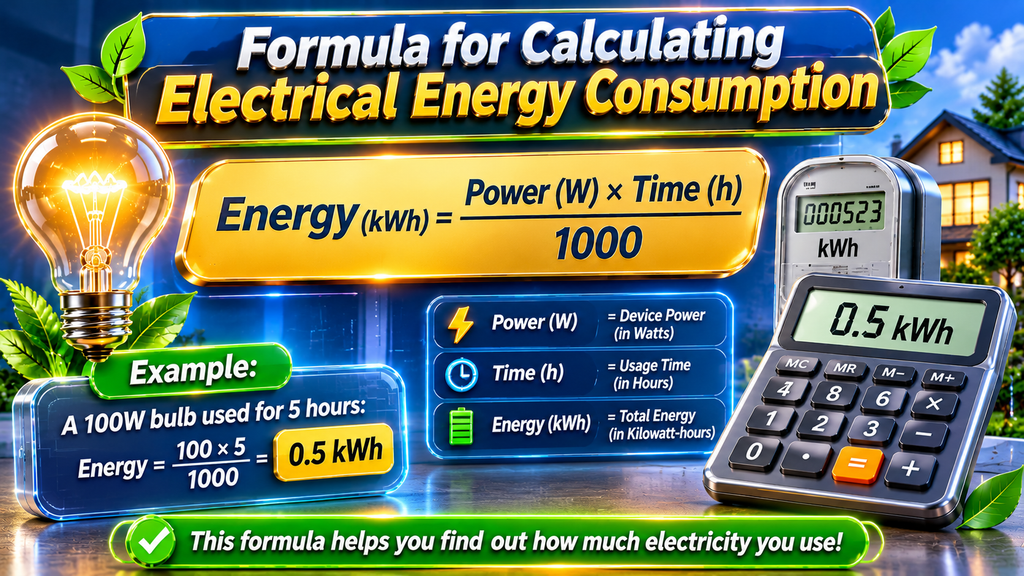
You can calculate electrical energy consumption manually by using a simple mathematical formula.
Electrical Energy Consumption = Power × Time
When power is measured in kilowatts and time is measured in hours, the result is expressed in kilowatt-hours (kWh).
The formula is:
Energy (kWh) = Power (W) × Operating Time (Hours) ÷ 1,000
Where:
- Energy: Total electrical energy consumed, measured in kWh.
- Power: The appliance’s rated power in watts.
- Operating Time: The number of hours the appliance operates.
- 1,000: The conversion factor used to change watts into kilowatts.
Example calculation:
Suppose you have a 200-watt television that operates for five hours every day.
Step 1: Identify the power rating.
Power = 200 W
Step 2: Enter the operating time.
Time = 5 hours
Step 3: Apply the formula.
Energy = 200 × 5 ÷ 1,000
Energy = 1 kWh per day
Step 4: Calculate monthly consumption.
At a daily usage of 1 kWh, the total electricity consumption over 30 days is 30 kWh.
The television therefore consumes approximately 30 units of electricity in a 30-day period, assuming it consistently uses its rated power.
An online electric energy consumption calculator can perform the same calculation automatically and reduce the effort required for repeated estimates.
4. How to Use an Electric Energy Consumption Calculator

Using an electric energy consumption calculator is simple, even if you have limited technical knowledge. You only need to collect a few details about the appliance you want to evaluate.
Follow these steps:
Step 1: Find the Appliance’s Power Rating
Check the product label, user manual, or manufacturer’s specifications to find its power rating. The value is usually displayed in watts (W).
Step 2: Enter the Power Value
Type the appliance’s wattage into the calculator. If the power rating is already provided in kilowatts, make sure you select the correct unit.
Step 3: Add Daily Operating Hours
Specify how many hours per day the appliance is in use.For example, a fan running for six hours should have a daily operating time of six hours.
Step 4: Select the Number of Days
Choose the period for which you want to estimate consumption. You can calculate daily, weekly, or monthly energy usage, depending on the calculator’s available options.
Step 5: Enter Your Electricity Rate
If you want to calculate the electricity cost, provide the rate charged for each kWh.This allows the tool to estimate the appliance’s operating cost.
Step 6: Calculate and Review the Results
Select the Calculate button to see the estimated amount of electricity used. Review the kWh value and estimated cost to understand the appliance’s electricity requirements.
For better results, use realistic operating hours instead of assuming that every appliance runs continuously.
5.Estimating Your Electricity Bill Based on Energy Usage
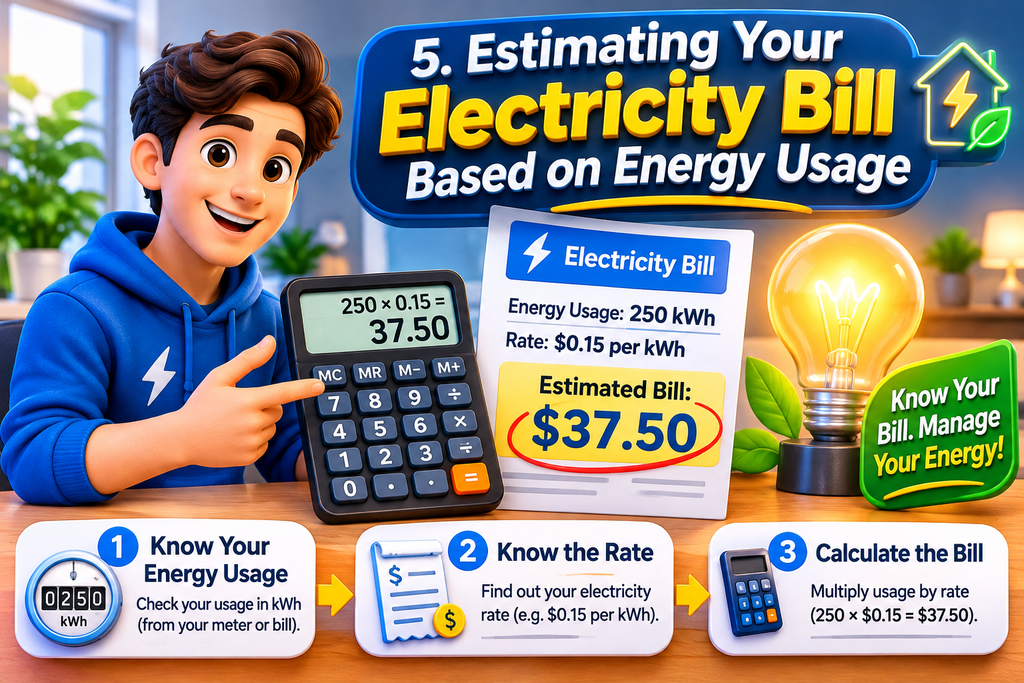
Knowing how many units of electricity an appliance consumes is useful, but understanding the associated cost is equally important.
Electricity providers generally calculate energy charges using the number of kilowatt-hours consumed and the applicable price per unit.
The basic formula is:
Electricity Cost = Energy Consumption (kWh) × Electricity Rate per kWh
For example, suppose an appliance consumes 45 kWh of electricity in one month and your electricity rate is $0.15 per kWh.
The estimated cost is:
45 × 0.15 = $6.75
This means the appliance’s estimated energy charge is $6.75 for that month.
You can use the same method to estimate electricity expenses for an entire home or office by adding the consumption of individual appliances.
Keep in mind that your actual electricity bill may include additional charges, such as fixed fees, taxes, fuel adjustments, demand charges, or other provider-specific costs. In some locations, electricity rates also change according to usage levels or time of day.
Therefore, an online calculator provides an estimated energy cost rather than a guaranteed final bill amount.
6. Common Appliances and Their Electricity Consumption

Different electrical appliances consume different amounts of energy. Their consumption depends on power ratings, operating time, efficiency, and usage conditions.
The following table provides illustrative estimates for common household devices.
| Appliance | Example Power Rating | Daily Usage | Daily Consumption |
| LED Bulb | 10 W | 8 hours | 0.08 kWh |
| Ceiling Fan | 75 W | 10 hours | 0.75 kWh |
| Television | 100 W | 5 hours | 0.50 kWh |
| Laptop | 65 W | 6 hours | 0.39 kWh |
| Refrigerator | 150 W | 8 equivalent hours | 1.20 kWh |
| Washing Machine | 500 W | 1 hour | 0.50 kWh |
| Electric Heater | 1,500 W | 3 hours | 4.50 kWh |
| Air Conditioner | 1,500 W | 6 equivalent hours | 9.00 kWh |
These are simplified examples, not universal appliance consumption figures. Actual usage may differ significantly. Refrigerators and inverter appliances, in particular, cycle or adjust their power rather than operating continuously at their rated wattage.
The table demonstrates why checking appliance power ratings and operating patterns is important.
For example, an electric heater may consume considerably more energy than an LED bulb because it has a much higher power rating. Similarly, an air conditioner can contribute significantly to household electricity usage when operated for long periods.
Using an electricity consumption calculator helps you estimate these differences and identify opportunities to reduce unnecessary energy use.
7. Benefits of Using an Electric Energy Consumption Calculator

An electric energy consumption calculator offers several advantages for people who want to monitor and manage electricity usage.
Better Budget Management: Estimating appliance consumption helps households predict electricity expenses and organize monthly budgets.
Identifying High-Energy Appliances: The calculator makes it easier to recognize devices that may be responsible for a large share of electricity usage.
Comparing Appliance Efficiency: You can compare the estimated energy requirements of different appliances before purchasing new equipment.
Reducing Electricity Waste: Understanding consumption encourages users to switch off unnecessary devices and avoid leaving equipment running without a reason.
Supporting Business Planning: Businesses can estimate equipment energy requirements and include electricity expenses in their operating budgets.
Understanding Energy Usage: Students and beginners can use the calculator to learn how watts, kilowatts, operating hours, and kilowatt-hours are connected.
Evaluating Energy-Saving Changes: You can calculate estimated consumption before and after changing operating hours or replacing an appliance.
Although the calculator cannot guarantee lower electricity bills, it provides useful information that supports more informed energy decisions.
8. Practical Ways to Reduce Electricity Consumption

Once you understand how much energy your appliances use, you can take practical steps to reduce unnecessary consumption.
Here are some useful methods:
Choose Energy-Efficient Appliances: Look for appliances with good energy-efficiency ratings. Efficient models can perform similar tasks while consuming less electricity.
Use LED Lighting: Replacing traditional incandescent bulbs with LED alternatives can reduce the electricity needed for lighting.
Switch Off Unused Equipment: Turn off lights, fans, televisions, and other devices when they are not required.
Avoid Unnecessary Standby Power: Some electronic devices continue using electricity even when they are not actively operating. Unplugging unused equipment or using suitable switched power strips can help reduce this consumption.
Maintain Air Conditioners: Clean filters and proper maintenance help air conditioning systems operate more efficiently.
Manage Cooling and Heating Settings: Avoid unnecessarily low cooling or high heating settings. Choose comfortable temperatures that do not place excessive demands on the equipment.
Use Natural Light: Open curtains and use daylight whenever practical to reduce dependence on artificial lighting.
Monitor Your Electricity Usage: Review your energy consumption regularly. Comparing estimated usage across different months can help you identify changes and unusual increases.
Small adjustments can make a meaningful difference over time, particularly when several high-consumption appliances are involved.
Conclusion
An electric energy consumption calculator is a practical resource for understanding how much electricity your appliances and electrical equipment use. By entering power ratings and operating hours, you can estimate daily, weekly, or monthly energy consumption in kilowatt-hours.
The calculator also helps you estimate electricity costs, compare appliances, identify energy-intensive devices, and plan household or business expenses. Understanding the relationship between watts,
kilowatts, operating time, and kWh makes it easier to interpret electricity usage.
Whether you want to manage household expenses or monitor equipment usage at work, an electric energy consumption calculator can help you make informed decisions and develop better electricity-saving habits.
For more useful results, enter realistic appliance information and compare your estimates with actual meter readings or electricity bills. Remember that calculated values are estimates because real-world energy consumption can change with operating conditions.
Frequently Asked Questions (FAQs)
1. What is an electric energy consumption calculator?
An electric energy consumption calculator is an online tool that estimates how much electrical energy an appliance or system uses over a selected period. It usually calculates consumption in kilowatt-hours (kWh).
2. How do I calculate electricity consumption in kWh?
Multiply the appliance’s power rating in watts by its operating hours, then divide the result by 1,000. For example, a 1,000-watt appliance running for two hours consumes 2 kWh.
3. What does kWh mean on an electricity bill?
kWh stands for kilowatt-hour. It is a unit of energy that represents the electricity used by a device operating at one kilowatt of power for one hour. Electricity providers commonly use kWh to measure billed energy consumption.
4. How can I calculate the monthly electricity usage of an appliance?
Multiply the appliance’s power in kilowatts by its average daily operating hours and the number of days in the month. The result gives an estimated monthly consumption in kWh.
5. Does an electric energy consumption calculator estimate electricity costs?
Many calculators include an electricity cost feature. Enter your estimated kWh consumption and electricity rate per unit to calculate the approximate energy charge.
6. Which household appliances consume the most electricity?
Air conditioners, electric heaters, water heaters, clothes dryers, and other high-power appliances can use substantial amounts of electricity. Actual consumption depends on their efficiency, power demand, and operating time.
7. Is a 1,000-watt appliance equal to 1 kWh?
No. A 1,000-watt appliance uses 1 kilowatt of power. It consumes 1 kWh of energy when it operates at that power level for one hour.
8. Can I calculate electricity consumption for multiple appliances?
Yes. Calculate the estimated kWh consumption of each appliance separately and add the results together. This gives an approximate total for all the devices over the selected period.
9. Why is my actual electricity bill different from the calculator’s estimate?
The difference may result from changing appliance loads, standby consumption, inaccurate operating hours, electricity rate variations, taxes, fixed charges, and other billing adjustments.
10. How can I reduce my monthly electricity consumption?
Use energy-efficient appliances, switch off unused devices, choose LED lighting, maintain cooling equipment, and monitor operating hours. These habits can help reduce unnecessary electricity usage.