
Introduction

Running a small business often means handling many responsibilities with limited time and resources. Owners may need to manage customers, marketing, sales, finances, communication, and daily operations at the same time. AI software for small business can make these responsibilities easier by helping automate repetitive work and supporting faster decision-making.
Artificial intelligence tools are no longer limited to large corporations. Many affordable and easy-to-use solutions are now available for small companies, freelancers, startups, and online businesses. When used correctly, AI can reduce manual work while allowing business owners and employees to focus on tasks that require creativity and human judgment.
What Is AI Software for Small Business?
AI software refers to digital applications that use artificial intelligence to perform or assist with business-related tasks. These tools can analyze information, generate content, answer questions, organize data, communicate with customers, and automate repetitive processes.
For a small business, AI does not necessarily mean replacing employees. Instead, it can act as an assistant that helps people complete routine activities more efficiently.
For example, an AI tool may help write an email, summarize a document, organize customer information, create marketing ideas, or respond to common customer questions.
Why Small Businesses Are Using AI Tools
One major reason businesses adopt AI is the ability to save time. Repetitive tasks can consume hours that could otherwise be spent on sales, customer relationships, or business development.
AI can also help small companies work with fewer resources. A business owner may use AI to support content creation, marketing planning, customer communication, and data analysis without needing separate tools or additional staff for every task.
Another advantage is consistency. AI-powered systems can follow predefined instructions and processes, which can help businesses maintain organized workflows.
However, AI should be treated as a support system rather than a replacement for human expertise. Important decisions should still be reviewed by people.
AI Software for Marketing
Marketing is an area where small businesses can benefit significantly from artificial intelligence. AI tools can assist with creating blog ideas, social media content, advertising copy, email campaigns, and product descriptions.
Some platforms can also analyze customer behavior and help identify patterns. This information can support better marketing decisions.
For example, a small online store could use AI to create product descriptions and generate ideas for social media posts. A local service business could use AI to develop content ideas based on questions customers frequently ask.
AI can make marketing faster, but businesses should always review generated content before publishing it.
AI for Customer Support

Customer service can take a significant amount of time, especially when businesses receive similar questions repeatedly. AI-powered chatbots and virtual assistants can help answer common questions at any time.
A chatbot can provide information about opening hours, services, pricing, delivery details, or basic policies. More complicated issues can then be transferred to a human representative.
This approach can improve response times while reducing the amount of repetitive communication handled manually.
Businesses should make sure customers can reach a real person when an issue requires personal attention or professional judgment.
AI for Sales and Lead Management

AI software can also support sales teams by organizing leads and identifying potential opportunities. Some systems can analyze customer interactions and help businesses determine which prospects may need follow-up.
AI can assist with drafting follow-up emails, categorizing leads, and summarizing conversations. This allows sales professionals to spend more time building relationships rather than performing administrative work.
For small companies with limited sales staff, these capabilities can be especially useful.
AI for Business Administration

Administrative work is another area where AI can provide valuable support. Small businesses regularly deal with emails, documents, meeting notes, scheduling, reports, and internal communication.
AI applications can summarize long documents, create meeting summaries, organize information, and help draft professional messages.
Some business platforms can also automate workflows between different applications. For example, information submitted through an online form could automatically be organized in a spreadsheet or customer management system.
AI for Content Creation
Creating useful content consistently can be difficult for a small business owner. AI writing tools can help generate outlines, headlines, product descriptions, social media ideas, and first drafts.
The best approach is to use AI as a starting point rather than publishing everything exactly as generated. Human editing can improve accuracy, originality, tone, and usefulness.
Businesses should also avoid producing large amounts of low-quality content simply because AI makes content creation faster.
How AI Can Reduce Business Costs
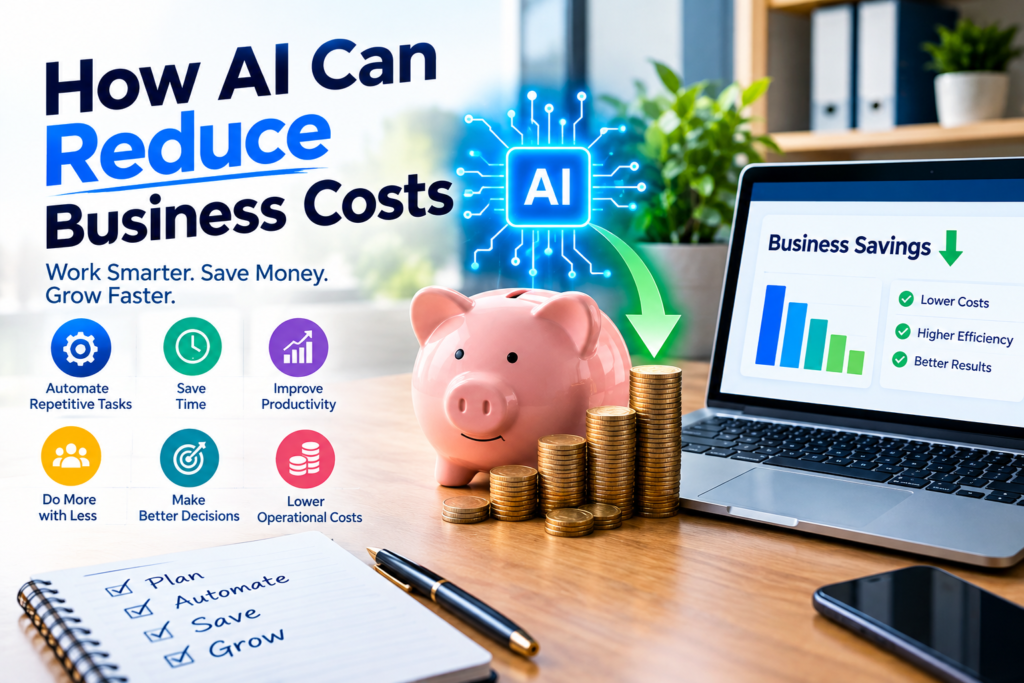
AI can potentially reduce operational costs by decreasing the amount of time employees spend on repetitive activities. When routine processes become faster, workers can dedicate more attention to valuable tasks.
For example, an employee who previously spent several hours preparing basic reports may use AI to create an initial summary and then spend more time analyzing the results.
The actual savings depend on the business, the software being used, and how effectively the system is implemented.
How to Choose AI Software for a Small Business
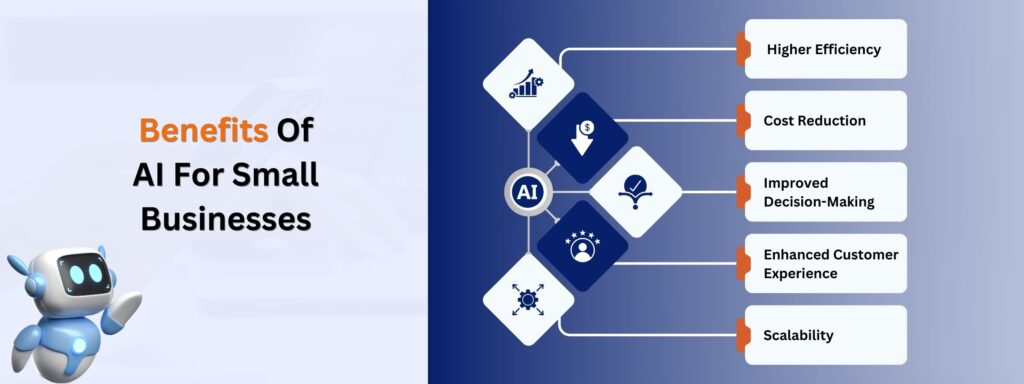
Small businesses should not choose an AI tool simply because it has many features. The software should solve a specific problem.
Before selecting a solution, consider:
- Business needs: Identify the task you want to improve.
- Cost: Compare the subscription price with the expected value.
- Ease of use: Choose software employees can learn quickly.
- Integrations: Check whether it works with your existing tools.
- Security: Understand how customer and business data is handled.
- Scalability: Make sure the software can support future growth.
Starting with one clear use case is usually better than introducing many AI tools at once.
Best Way to Start Using AI

A practical approach is to identify one repetitive or time-consuming business task. Then determine whether an AI solution can safely assist with that process.
Start with a small test and measure the results. Track factors such as time saved, productivity, customer response, or operating costs.
If the results are positive, the business can gradually expand AI usage into other areas.
Conclusion
AI software for small business can help companies save time, improve productivity, support customers, and manage everyday operations more efficiently. From marketing and content creation to sales and administration, AI can assist with many routine activities.
The key is to use AI strategically. Businesses should select tools based on actual needs, review AI-generated work, protect important information, and maintain human oversight. With the right approach, artificial intelligence can become a practical resource for small businesses looking to work smarter and grow sustainably.
FAQs
1. What is AI software for small business?
AI software for small business consists of applications that use artificial intelligence to assist with tasks such as marketing, customer service, content creation, sales, and administration.
2. Can small businesses afford AI software?
Many AI platforms offer affordable plans, free versions, or pay-as-you-go options. Businesses should compare the cost with the time and resources the software can save.
3. How can AI help a small business?
AI can automate repetitive activities, assist with customer communication, generate content, analyze information, organize workflows, and support business decisions.
4. Can AI replace small business employees?
AI is generally more useful as a support tool than as a complete replacement for employees. Human judgment, creativity, communication, and decision-making remain important.
5. What should a business consider before using AI?
Businesses should consider cost, security, ease of use, integrations, accuracy, privacy, and whether the software actually solves a meaningful business problem.