
Introduction

AI Productivity Tools are changing the way people manage their daily work. From writing emails and creating documents to organizing tasks and analyzing information, artificial intelligence can help users complete many routine activities more efficiently.
Students, freelancers, marketers, business owners, and office professionals can use AI-powered software to reduce repetitive work and focus more attention on important tasks. Instead of replacing every human activity, these tools are mainly useful for assisting with planning, writing, research, organization, and automation.
As AI technology continues to develop, productivity tools are becoming easier to use and more accessible for individuals and businesses.
What Are AI Productivity Tools?

AI productivity tools are software applications that use artificial intelligence to help users complete tasks faster or with less manual effort. They can understand text, generate content, summarize information, organize data, automate repetitive processes, and provide suggestions.
Unlike traditional productivity software, AI-powered applications can often respond to natural-language instructions. This allows users to describe what they need instead of manually performing every step.
For example, a user can ask an AI tool to summarize a long document, create a task list from meeting notes, or generate ideas for a project.
Why Are AI Productivity Tools Important?

Modern professionals often have to handle many tasks within limited time. Managing emails, meetings, research, documents, social media, customer communication, and project planning can become difficult.
AI productivity software can reduce some of this workload. By automating repetitive activities, users can spend more time on decision-making and creative work.
Some major benefits include:
- Faster completion of routine tasks
- Better organization
- Assistance with writing and editing
- Quick information summarization
- Improved workflow management
- Reduced repetitive manual work
- Support for brainstorming and research
However, AI-generated results should still be reviewed by humans, especially when accuracy is important.
Popular Uses of AI Productivity Tools
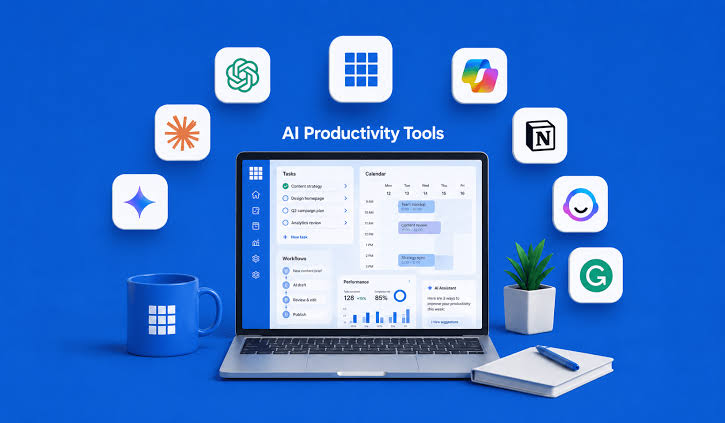
AI can support productivity in many different areas. The best use depends on the user’s goals and type of work.
AI Writing Assistance
Writing assistants can help create drafts, rewrite sentences, correct grammar, and adjust the tone of written content.
They can be useful for emails, reports, blog posts, product descriptions, social media captions, and business communication.
AI should be treated as an assistant rather than an automatic replacement for human editing. Reviewing generated text helps maintain accuracy, originality, and the appropriate voice.
Task and Project Management

AI can make task management easier by helping users organize projects and prioritize activities.
For example, a project plan can be converted into smaller tasks, deadlines can be organized, and routine reminders can be automated.
This can be especially useful for teams managing several projects at the same time.
Meeting Summaries
Long meetings can generate a large amount of information. AI-powered meeting assistants can help turn conversations into summaries, key points, and action items.
Instead of manually writing every detail, users can focus on participating in the discussion and reviewing the generated notes afterward.
Research and Summarization

AI tools can help users understand large amounts of information more quickly. They can summarize documents, identify important points, and organize information into easier-to-read formats.
This can save time for students, researchers, marketers, and professionals who regularly work with lengthy material.
Important facts should still be verified using reliable sources before being used in professional or academic work.
AI Productivity Tools for Businesses

Businesses can use AI to improve workflows across different departments.
Marketing teams can use AI for content ideas, campaign planning, customer communication, and data analysis. Sales teams can use automation to organize leads and prepare communication. Customer support departments can use AI assistants to answer common questions.
Small businesses can also benefit because AI can help them perform certain tasks without requiring a large team.
The key is to identify repetitive activities where automation can provide genuine value rather than adding AI simply because it is popular.
AI Productivity Tools for Students

Students can use AI tools as learning assistants when used responsibly.
AI can help explain difficult concepts, summarize study material, create revision questions, organize notes, and develop study plans.
For example, a student can provide a topic and ask an AI assistant to explain it at a beginner level. The student can then use the explanation as a starting point for deeper learning.
Students should follow their school’s or institution’s rules regarding AI-generated work and should not rely on AI as a substitute for learning.
Choosing the Best AI Productivity Tool for Your Needs
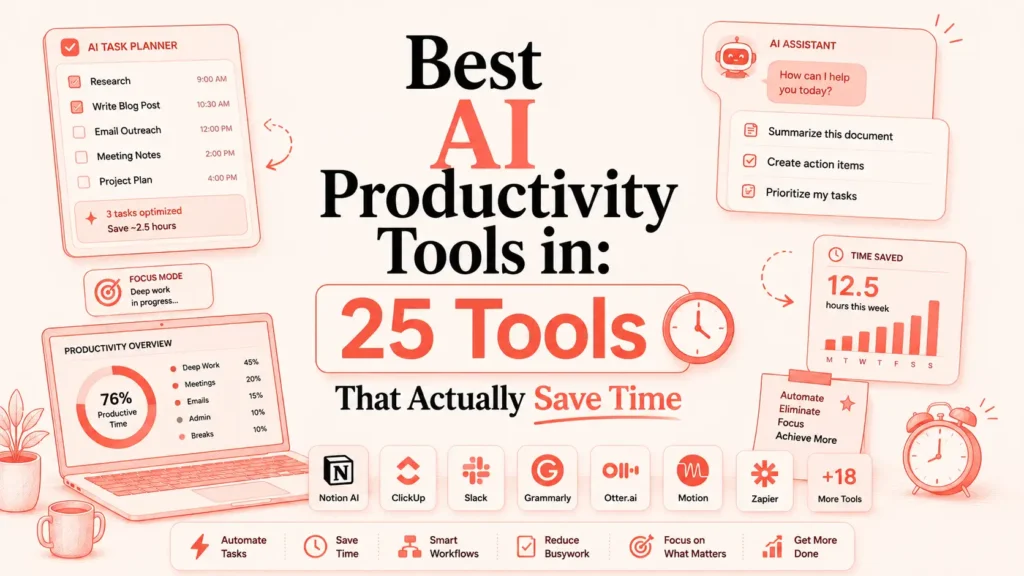
There are many AI applications available, so choosing the right one can be difficult. Consider the following factors before selecting a tool.
Identify Your Main Need
First decide what you want the software to accomplish. Writing, project management, research, automation, design, and communication may require different solutions.
Check Ease of Use
A powerful tool is not useful if it is difficult to operate. Look for an interface that matches your technical knowledge and workflow.
Review Features

Compare important features such as integrations, automation options, collaboration tools, file support, and AI capabilities.
Consider Cost
Some AI productivity tools offer free plans, while advanced features may require subscriptions. Choose an option that provides enough value for your budget.
Protect Your Information

Avoid entering confidential business information, passwords, financial details, or sensitive customer data into AI services unless you understand how that service handles your information.
Best Practices for Using AI Productivity Tools

Using AI effectively requires more than simply giving it instructions. Clear prompts usually produce more useful results.
Be specific about your goal, format, audience, and requirements. After receiving an AI-generated result, check it for mistakes and make necessary improvements.
It is also useful to combine AI assistance with human judgment. AI can speed up many processes, but users remain responsible for reviewing important information and making final decisions.
Are AI Productivity Tools Replacing Human Workers?

AI productivity tools are more commonly used to assist workers than completely replace them. They can handle repetitive tasks and provide suggestions, allowing people to focus on activities that require creativity, judgment, communication, and strategic thinking.
The impact will vary between industries and jobs. People who learn how to use AI effectively may be better prepared for workplaces where AI-assisted workflows become increasingly common.
Future of AI Productivity Tools

AI productivity software is likely to become more integrated into everyday digital workflows. Future tools may provide more personalized assistance, automate complex processes, and connect different applications together.
Instead of using separate software for every small task, users may increasingly rely on AI assistants that can coordinate multiple activities from a single interface.
This development could make digital work faster and more convenient while also increasing the importance of human oversight, privacy, and responsible AI use.
Conclusion
AI Productivity Tools can help individuals and businesses save time, organize work, generate ideas, and automate repetitive activities. Their usefulness depends on choosing the right tool and applying it to tasks where AI can provide genuine assistance.
Whether you are a student, freelancer, marketer, or business professional, learning to use AI effectively can improve your workflow. The best approach is to combine AI’s speed and automation with human creativity, judgment, and careful review.
FAQs
What are AI Productivity Tools?
AI Productivity Tools are software applications that use artificial intelligence to assist with tasks such as writing, research, planning, organization, automation, and communication.
How can AI tools improve productivity?
They can reduce repetitive work, summarize information, assist with writing, organize tasks, and help users complete certain activities more efficiently.
Are AI productivity tools free?
Some tools provide free versions, while others offer additional features through paid subscriptions. Pricing varies between platforms.
Can students use AI productivity tools?
Yes. Students can use them for tasks such as studying, summarizing information, organizing notes, and understanding difficult concepts, while following their institution’s AI policies.
Are AI productivity tools accurate?
AI tools can produce incorrect or incomplete information. Important results should always be reviewed and verified before being relied upon.
How do I choose the best AI productivity tool?
Start by identifying your main need, then compare features, ease of use, integrations, pricing, privacy practices, and overall usefulness.