
1. What Is Lead Generation Content Marketing?
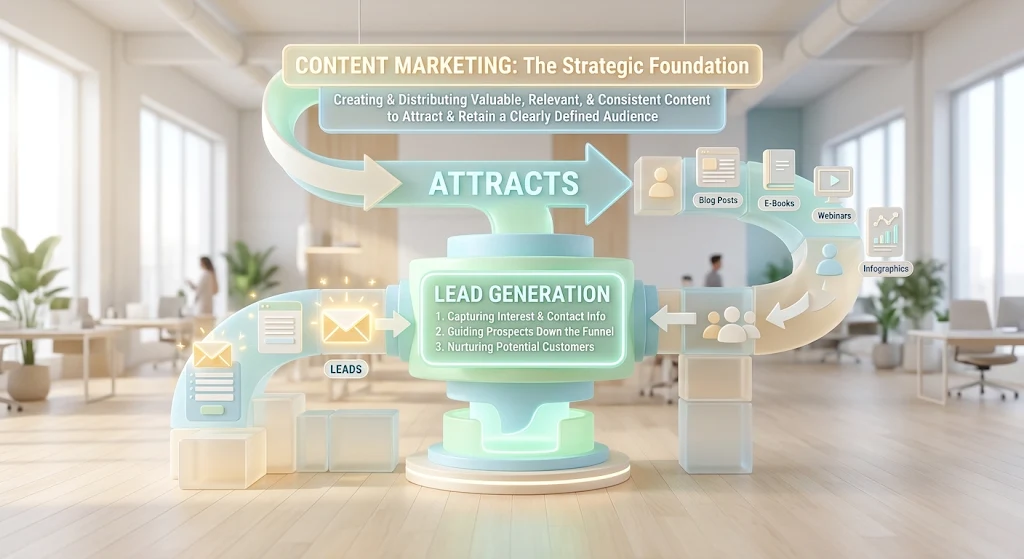
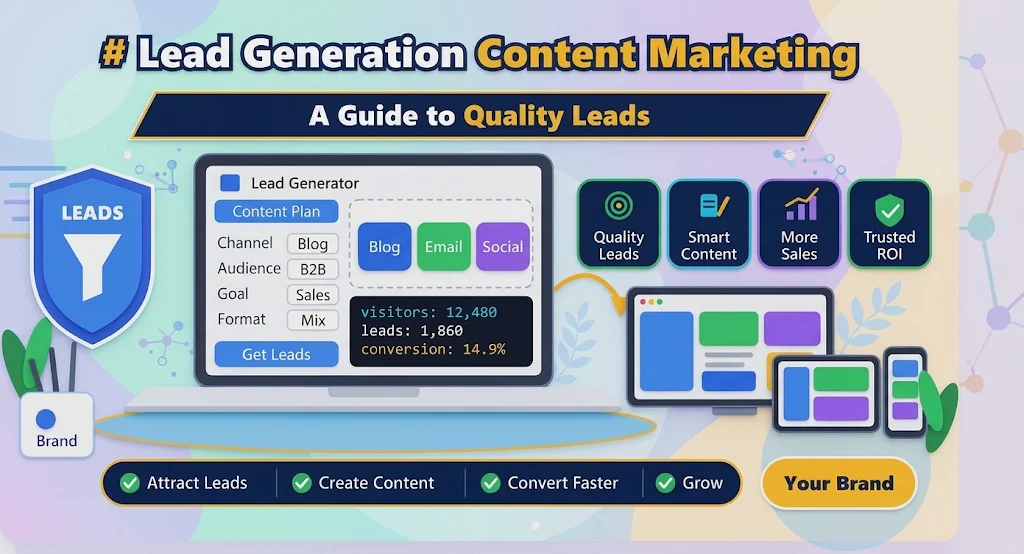
Lead generation content marketing is a digital marketing strategy that uses valuable, informative, and relevant content to attract potential customers and encourage them to share their contact information with a business.
Instead of directly asking people to purchase a product or service, businesses provide useful information that solves problems, answers questions, and builds trust. When visitors find the content helpful, they may become interested in learning more about the company’s products or services.
The process typically involves publishing blog posts, creating downloadable guides, offering free resources, sharing videos, and developing landing pages that encourage visitors to take specific actions.
For example, a software company might publish an article explaining how businesses can improve their productivity. At the end of the article, it could offer a free productivity checklist in exchange for the visitor’s email address.
This exchange creates an opportunity for the business to communicate with an interested potential customer.
How Does It Work?
The process generally follows four stages:
- Attract: Publish useful content that brings relevant visitors to your website.
- Engage: Provide information that answers their questions and solves their problems.
- Capture: Encourage interested visitors to complete a form, subscribe to a newsletter, or request a consultation.
- Nurture: Continue sharing relevant information until potential customers are ready to make a purchasing decision.
The main objective is not simply to increase website traffic. It is to attract the right audience and convert interested visitors into meaningful business opportunities.
A website receiving thousands of visitors may generate fewer sales than a smaller website attracting highly relevant visitors. This is why content quality, audience targeting, and conversion strategy are important.
2. Why Is Content Marketing Important for Lead Generation?

Content marketing plays an important role in modern customer acquisition because people frequently research products and services before making purchasing decisions.
Potential customers want to understand their problems, compare available solutions, and identify businesses they can trust.
Useful content helps businesses become visible during this research process.
Builds Trust and Credibility
Customers are more likely to consider a business when it consistently provides useful information.
Educational articles, detailed guides, case studies, and helpful tutorials demonstrate that a company understands its industry and audience.
For example, a digital marketing agency that regularly publishes practical SEO guides can attract website owners who may eventually need professional SEO services.
Attracts Targeted Website Traffic
Search engine optimized content helps businesses reach people who are actively searching for relevant information.
Instead of targeting everyone, companies can create content around specific search queries and customer problems.
This approach helps attract visitors who have a genuine interest in the business’s offerings.
Generates Leads Over Time
A useful blog post or downloadable resource can continue attracting potential customers after publication.
Unlike some advertising campaigns that stop generating traffic when the budget ends, well-maintained organic content may continue bringing visitors through search engines and other distribution channels.
However, results depend on search demand, competition, content quality, and ongoing optimization.
Supports the Customer Buying Journey
Not every visitor is ready to purchase immediately.
People may be at different stages of their buying journey, from identifying a challenge to evaluating the best available solutions.
Content marketing supports these different stages by providing educational resources, comparisons, product information, and decision-making guidance.
Improves Brand Awareness
Publishing consistent and relevant content helps people recognize a brand.
When audiences repeatedly encounter useful information from the same business, they may become more familiar with its expertise and services.
This familiarity can make future interactions easier and more productive.
3. Best Content Marketing Strategies for Generating Quality Leads
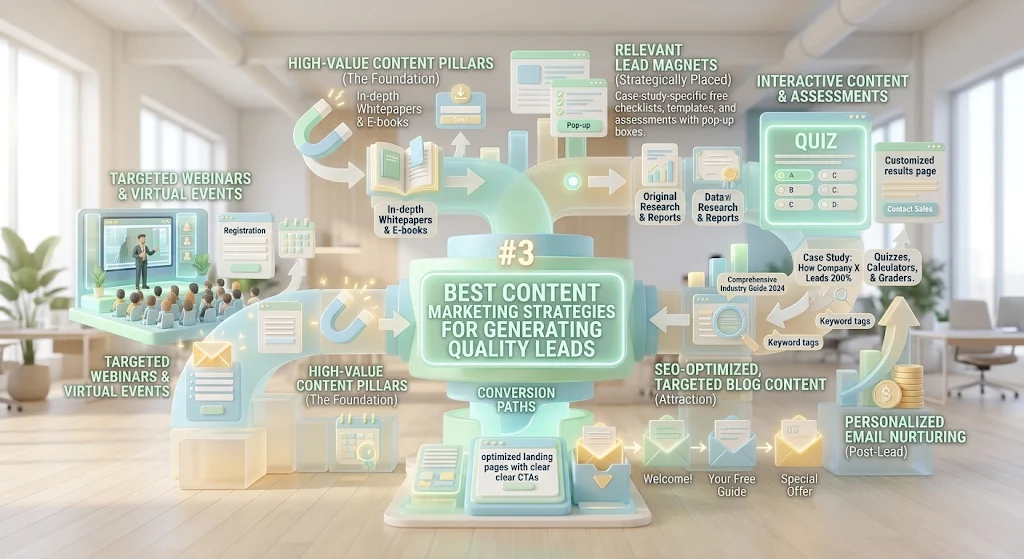
An effective lead generation strategy requires more than publishing random blog posts. Businesses should select content formats based on their audience, industry, and marketing objectives.
The following strategies can help attract and convert potential customers.
Create SEO-Optimized Blog Posts
Blogging is one of the most accessible ways to attract organic website traffic.
Businesses can publish articles that answer frequently asked questions, explain industry concepts, compare solutions, and solve common customer problems.
For example, a web development company could publish articles about website performance, WordPress security, responsive design, and website maintenance.
To improve lead generation through blogging:
- Research relevant keywords.
- Understand the search intent behind each query.
- Write informative and original articles.
- Include relevant internal links.
- Add useful calls to action.
- Keep important information updated.
A blog post should provide genuine value rather than exist only to promote a product.
Offer Free Ebooks and Guides
Downloadable resources can encourage visitors to exchange their contact information for valuable information.
Examples include:
- Beginner’s marketing guides
- SEO checklists
- Industry reports
- Business planning templates
- Step-by-step tutorials
- Educational ebooks
For example, an agency could offer a free SEO audit checklist to website owners who want to improve their search visibility.
The resource should solve a specific problem and deliver enough value to justify requesting personal information.
Use Case Studies
Case studies explain how a business helped a customer overcome a particular challenge.
They are particularly useful for companies offering professional services, software, consulting, and B2B solutions.
A good case study generally includes:
- The customer’s original problem.
- The solution provided.
- The implementation process.
- Measurable results, when verified.
- Lessons learned.
Case studies provide practical evidence that helps potential customers evaluate a business’s capabilities.
Create Educational Videos
Video content can explain complicated subjects in a more engaging format.
Businesses can publish tutorials, product demonstrations, expert discussions, and customer education videos.
A software company, for example, can create a video showing how its platform helps users complete a particular task.
Videos can also direct viewers toward related guides, free trials, consultation pages, or useful downloadable resources.
Develop Helpful Email Content
Email marketing supports lead nurturing by allowing businesses to communicate with people who have voluntarily subscribed or otherwise provided appropriate marketing consent.
Companies can send:
- Educational newsletters
- Helpful tutorials
- Product updates
- Industry insights
- Relevant case studies
- Special offers
The goal should be to maintain useful communication rather than send repeated promotional messages.
Publish Comparison Articles
People researching products often compare different solutions before purchasing.
Comparison articles can help them understand the differences between available options.
For example:
- Free vs paid SEO tools
- WordPress vs custom website development
- Email marketing platforms compared
- Different hosting solutions
These articles can attract visitors with stronger purchasing intent because they are already evaluating potential solutions.
4. Types of Content That Attract Potential Customers
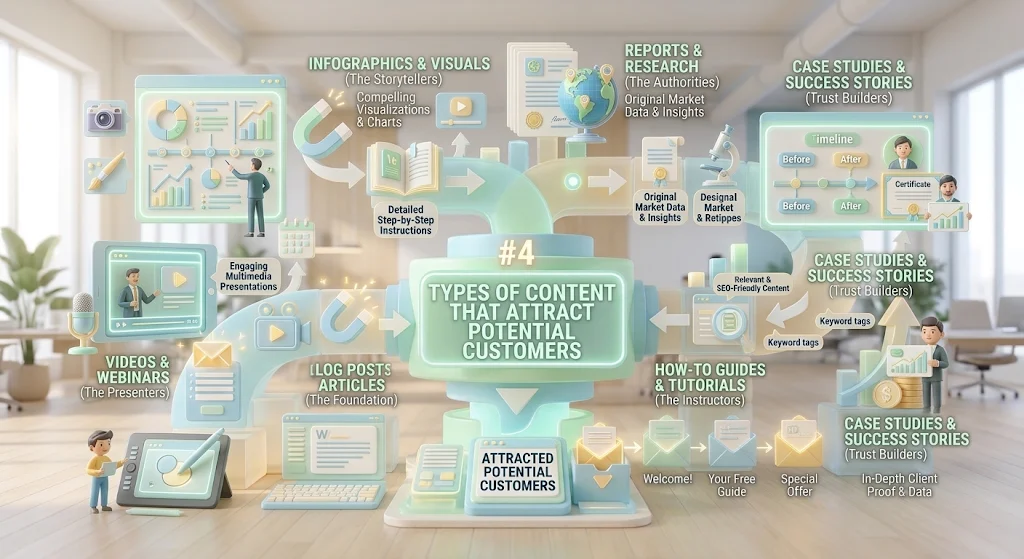
Different content formats serve different purposes throughout the customer journey.
Selecting the right format can improve engagement and help businesses capture more relevant leads.
Blog Articles
Blog articles are useful for answering search queries and attracting visitors through organic search.
They work especially well for educational content, industry insights, and informational keywords.
Landing Pages
Landing pages are designed to encourage visitors to complete a specific action.
A landing page may promote a free consultation, ebook, software demonstration, webinar, or service.
Effective landing pages generally include:
- A clear headline
- A relevant explanation of the offer
- Important benefits
- Supporting evidence
- A visible call to action
- A simple conversion form
Webinars
Webinars allow businesses to educate audiences through live or recorded presentations.
They are particularly useful for explaining complex services, demonstrating software, and discussing industry challenges.
Registration forms can help businesses collect information from interested participants.
Infographics
Infographics present information through visual elements such as charts, illustrations, and diagrams.
They can make complicated information easier to understand and share.
For example, a marketing agency might create an infographic explaining the stages of a lead generation funnel.
Free Tools and Templates
Free tools can attract visitors by solving specific problems.
Examples include:
- SEO calculators
- Budget planners
- Website checklists
- Content calendars
- Business templates
- Marketing assessment tools
A useful free resource can create a natural connection between a visitor’s problem and a company’s paid services.
Frequently Asked Questions Content
FAQ pages answer common questions about products, services, pricing, and processes.
They help visitors find important information before contacting a business.
Clear answers can also support search visibility by matching question-based search queries.
5. How to Build a Lead Generation Content Marketing Funnel
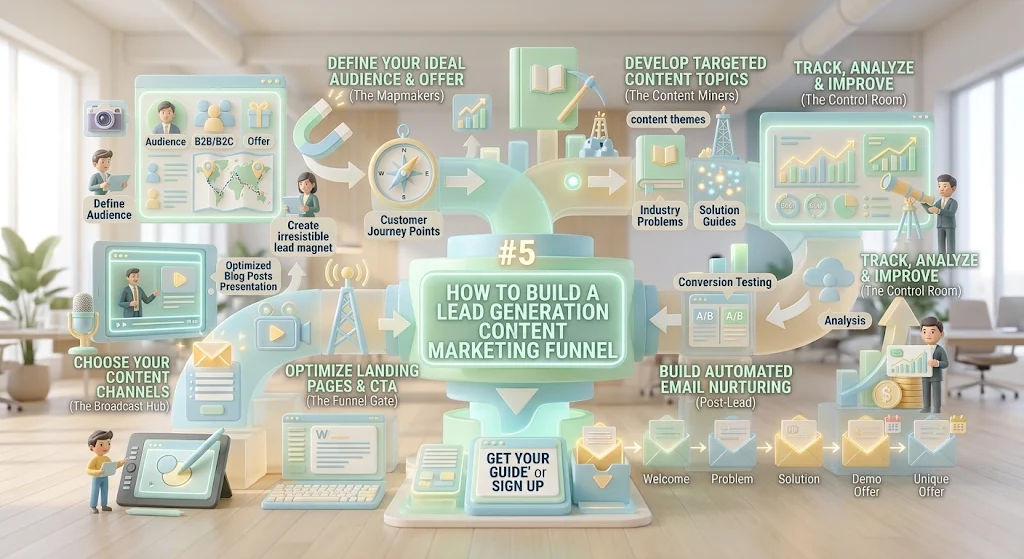
A content marketing funnel describes how potential customers move from discovering a business to becoming interested in its products or services.
Building a structured funnel helps businesses provide appropriate information at each stage.
Stage 1: Awareness
At this stage, people are discovering a problem or looking for general information.
They may not know which company or product can help them.
Suitable content includes:
- Beginner-friendly blog posts
- Educational videos
- Social media posts
- Industry guides
- Informational infographics
The objective is to attract relevant visitors and introduce your brand.
Stage 2: Consideration
At this stage, visitors understand their problem and begin researching possible solutions.
They may compare products, explore service options, and look for reliable recommendations.
Suitable content includes:
- Detailed guides
- Product comparisons
- Case studies
- Expert interviews
- Webinars
- Downloadable resources
The goal is to demonstrate expertise and help potential customers evaluate their options.
Stage 3: Conversion
At this stage, visitors are closer to making a purchasing decision.
They may need additional information before contacting a sales team or purchasing a product.
Useful content includes:
- Product demonstrations
- Free consultations
- Pricing information
- Customer testimonials
- Free trials
- Service landing pages
The objective is to make the next step clear and convenient.
Stage 4: Retention
Lead generation does not end when someone becomes a customer.
Businesses should continue providing helpful information to maintain relationships and encourage repeat purchases.
Useful content includes:
- Customer onboarding guides
- Product tutorials
- Helpful newsletters
- Knowledge base articles
- Product updates
- Customer education resources
A well-organized funnel helps businesses deliver relevant content instead of sending the same message to every visitor.
6. Best Tools for Lead Generation Content Marketing

The right marketing tools can make content creation, keyword research, email communication, and performance tracking easier.
Businesses do not need every available tool. They should select solutions based on their budget, requirements, and marketing objectives.
Google Analytics
Google Analytics helps website owners understand how visitors interact with their websites.
Businesses can use it to analyze traffic sources, user engagement, and important conversion events.
It can help identify which content attracts visitors and contributes to business goals.
Google Search Console
Google Search Console provides information about a website’s performance in Google Search.
It helps website owners understand:
- Search queries
- Search impressions
- Clicks
- Average search positions
- Indexing issues
- Website search visibility
These insights can help content marketers identify opportunities for improving existing articles and creating relevant new content.
Semrush
Semrush provides SEO and digital marketing features, including keyword research, competitor analysis, and website performance insights.
Content marketers can use these features to discover potential content topics and understand the competitive landscape.
Ahrefs
Ahrefs offers SEO research features that help users analyze keywords, backlinks, and competing websites.
It can support content planning by helping marketers discover topics that may attract relevant organic traffic.
Mailchimp
Mailchimp provides email marketing features that businesses can use to manage subscribers, create campaigns, and automate certain marketing communications.
It can be useful for businesses building email-based lead nurturing workflows.
WordPress
WordPress is a popular platform for creating and managing business websites, blogs, landing pages, and content resources.
It can support content marketing through publishing features, themes, and plugins.
If you are building a website for your marketing activities, explore our guide to Best Free WordPress Themes for Beginners in 2026.
Choose tools according to actual business needs instead of purchasing multiple subscriptions without a clear strategy.
7. How to Measure and Improve Lead Generation Content Marketing Results

Publishing content is only one part of a successful strategy. Businesses also need to measure performance to understand whether their content is attracting the right audience and generating meaningful opportunities.
Track Website Traffic
Monitor how many visitors reach your website and which channels bring them.
Important traffic sources may include:
- Organic search
- Social media
- Email campaigns
- Referral websites
- Direct traffic
- Paid advertising
Traffic alone does not indicate success, but it helps identify content distribution opportunities.
Measure Conversion Rate
Conversion rate shows the percentage of visitors who complete a desired action.
A basic formula is:
Conversion Rate = (Number of Conversions ÷ Total Visitors) × 100
For example, if 1,000 people visit a landing page and 50 complete the registration form, the conversion rate is 5%.
Different businesses may define conversions differently, including newsletter subscriptions, demo requests, consultation bookings, and purchases.
Monitor Lead Quality
Not every lead has the same value.
A business should evaluate whether leads match its target audience and have a realistic interest in its offerings.
Useful indicators may include:
- Industry relevance
- Business requirements
- Purchasing interest
- Budget suitability
- Engagement with content
- Sales qualification status
The objective is to generate qualified opportunities rather than simply collect large numbers of email addresses.
Calculate Cost Per Lead
Cost per lead helps businesses understand how much they spend to acquire each lead.
CPL = Total Lead Generation Cost ÷ Number of Leads Generated
For example, if a campaign costs $500 and generates 100 leads, its cost per lead is $5.
When calculating CPL, use a consistent definition of campaign costs and qualified or total leads.
Track Content Engagement
Engagement metrics can help identify whether visitors find content useful.
Depending on the platform and analytics setup, these may include:
- Average engagement time
- Scroll depth
- Video completion
- Newsletter clicks
- Download activity
- Return visits
Use these signals alongside actual lead and sales outcomes.
Improve Content Regularly
Review existing content to identify outdated information, missing explanations, weak calls to action, and opportunities to add useful examples.
Update content based on real audience questions and search performance.
For websites that also rely on WordPress plugins, maintaining a stable website is important. Read our guide on How to Fix Plugin Not Working in WordPress for practical troubleshooting advice.
Common Mistakes to Avoid
Businesses should avoid these common mistakes:
- Publishing content without understanding the target audience.
- Focusing only on website traffic.
- Using irrelevant keywords.
- Creating weak or unclear calls to action.
- Requesting too much information in forms.
- Ignoring mobile users.
- Sending excessive promotional emails.
- Failing to measure lead quality.
- Publishing content without updating outdated information.
- Making unsupported claims about business results.
A consistent measurement and improvement process helps businesses build a more effective content marketing system.
Conclusion
Lead generation content marketing is an effective way for businesses to attract potential customers, build credibility, and create meaningful relationships through valuable information.
Instead of focusing only on promotional messages, businesses should understand their audience’s challenges and create content that provides practical solutions. Blog posts, educational videos, downloadable guides, webinars, case studies, and landing pages can all contribute to a successful lead generation strategy.
The most important factor is choosing the right content for each stage of the customer journey. Businesses should attract relevant visitors, provide useful information, make conversion opportunities clear, and continue nurturing interested prospects.
It is also essential to measure performance. Tracking conversion rates, lead quality, website traffic, and cost per lead helps identify what works and where improvements are needed.
For long-term results, combine content marketing with SEO, audience research, email marketing, and regular content updates. A consistent and customer-focused approach can turn useful content into a sustainable source of qualified business leads.
FAQs About Lead Generation Content Marketing
1. What is lead generation content marketing?
Lead generation content marketing is a strategy that uses helpful and relevant content to attract potential customers and encourage them to share their contact details or take another meaningful action. It includes blog posts, ebooks, webinars, landing pages, videos, and email content.
2. How does content marketing generate leads?
Content marketing generates leads by attracting people who are searching for relevant information. Businesses provide useful resources and encourage interested visitors to subscribe, download a guide, request a consultation, or complete a registration form.
3. What type of content is best for lead generation?
The best content depends on the target audience and industry. Blog posts, case studies, downloadable guides, webinars, comparison articles, videos, and free tools can all generate leads when they address genuine customer needs.
4. Is SEO important for content marketing lead generation?
Yes. SEO helps content appear in relevant search results, allowing businesses to attract visitors who are actively researching particular topics, products, or services. Proper keyword research, helpful content, and technical optimization can support organic lead generation.
5. What is a lead generation funnel?
A lead generation funnel is a framework that explains how potential customers move from discovering a business to becoming interested in its products or services. Common stages include awareness, consideration, conversion, and retention.
6. How can small businesses generate leads through content marketing?
Small businesses can start by publishing helpful blog posts, creating useful social media content, offering free resources, optimizing landing pages, and building an email subscriber list. They should focus on a specific audience and create content that solves relevant problems.
7. How long does content marketing take to generate leads?
The timeline varies depending on industry competition, website authority, content quality, distribution, and marketing budget. Paid promotion and existing audiences may generate leads sooner, while organic search content often requires consistent publishing and optimization over time.
8. What is the difference between lead generation and content marketing?
Content marketing is the process of creating and distributing useful information to attract and engage an audience. Lead generation focuses on identifying and capturing potential customers. Content marketing can support lead generation, but the two terms do not mean exactly the same thing.
9. Which tools are useful for content marketing lead generation?
Useful tools include Google Analytics, Google Search Console, Semrush, Ahrefs, Mailchimp, and WordPress. Each supports different activities, such as analytics, keyword research, SEO, email campaigns, and website content management.
10. How can I measure the success of a lead generation content marketing campaign?
Measure website traffic, conversion rates, lead quality, cost per lead, engagement, and sales opportunities. These metrics help determine whether your content attracts relevant visitors and contributes to actual business objectives.